
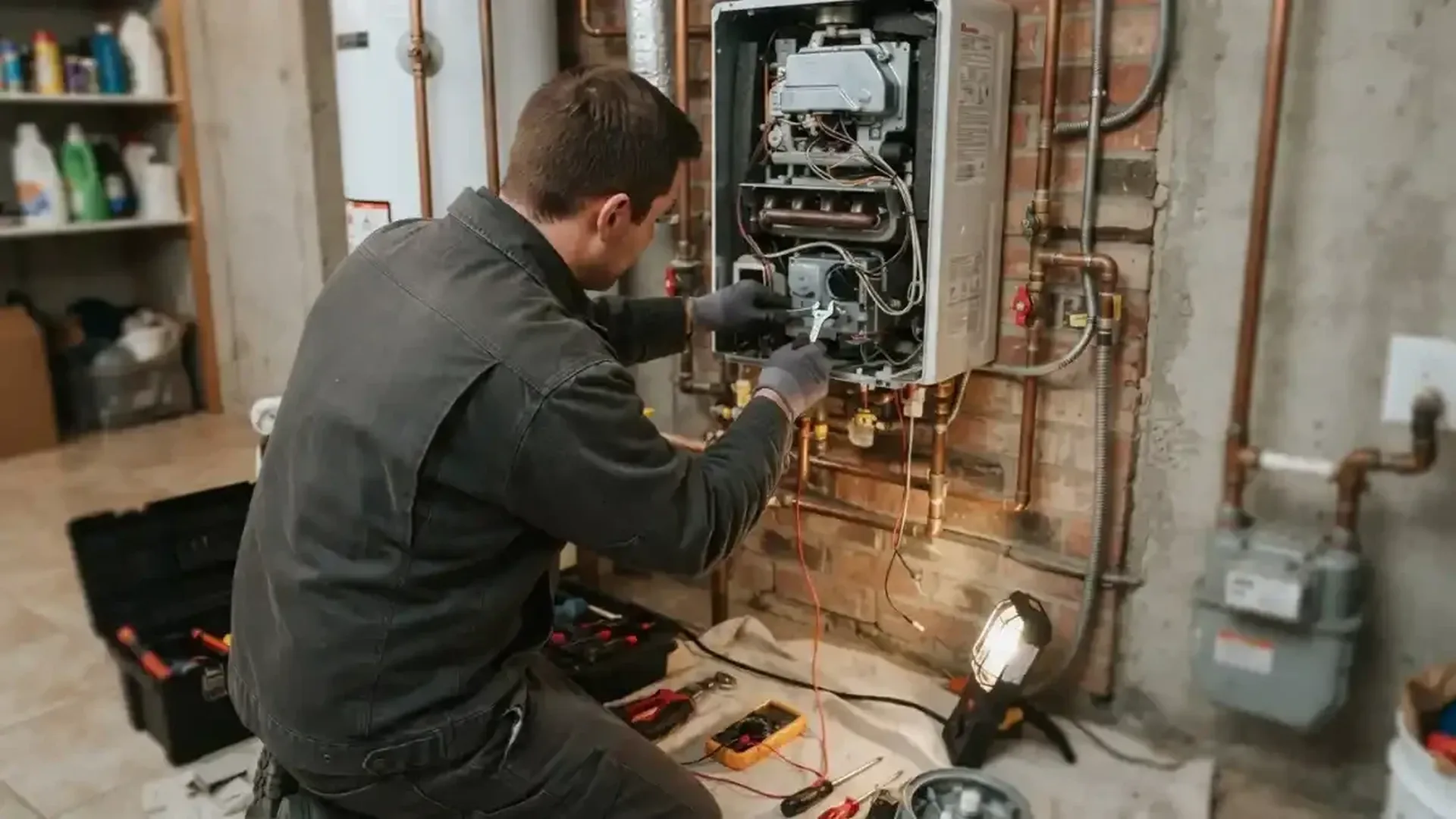
A boiler heats water and sends it through pipes to radiators or baseboards, which is why hydronic heat feels steadier than forced air. Boiler repair in Wyoming usually involves the water side: pressure, air, circulator pumps, valves and the expansion tank. Many Michigan homes depend on one all winter, so a cold house is worth a call the same day.
If you smell gas, do not fix anything first. Leave the house and call 911 or the gas utility from outside.
Gas or carbon monoxide first, repair second
If you smell gas, leave the building immediately, do not switch lights or devices on or off, and call 911 or DTE Energy, the area's natural gas utility, from outside. If a carbon monoxide alarm sounds, get everyone out into fresh air and call 911.
Only after the utility or fire department clears the house should you call a plumber. Boilers burn fuel, and flue or combustion problems are safety issues, not repairs to attempt yourself.
What no heat usually means
A cold house with a running boiler is a different problem from a boiler that will not start.
Boiler will not fire
Low water pressure, a tripped limit, a dead thermostat or a failed ignition can all stop it. Check the thermostat settings and the breaker before calling.
Boiler runs but radiators stay cold
Air trapped in the pipes, a failed circulator or a closed zone valve keeps hot water from circulating.
One zone is cold
A stuck zone valve or a trapped air pocket in that loop is typical. The rest of the house heating normally narrows it down.
Heat is weak
Scale buildup, a clogged strainer or low water in the system reduces output.
Boiler cycles constantly
Oversized equipment, a bad thermostat or pressure swings cause short cycling. It wastes fuel and wears parts.
Noises and leaks decoded
Boilers talk. The sound or the drip is a clue.
| Sign | Likely cause | What it means |
|---|---|---|
| Banging or knocking | Air or steam pockets, mineral scale | Bleed the air, check circulation |
| Gurgling in pipes | Trapped air | Bleed radiators, check the fill valve |
| Dripping from relief valve | Overpressure or a worn valve | Check pressure and expansion tank |
| Puddle under the boiler | Leaking fitting or heat exchanger | Shut down and call |
| Kettle-like rumble | Scale on the heat exchanger | Flush or descale |
Pressure, the expansion tank and the relief valve
A hydronic system is a sealed loop. The boiler holds a set pressure, and a small expansion tank absorbs the extra volume as water heats. When the tank loses its air charge, pressure spikes every time the boiler fires, and the relief valve opens and drips.
A dripping relief valve is a symptom, not the disease. Replacing the valve alone usually brings the drip back within weeks if the tank or fill valve is the cause.
Safety steps before you touch the boiler
- If you smell gas, leave the house at once and call 911 or DTE Energy from outside.
- If a carbon monoxide alarm sounds, get everyone outdoors and call 911.
- Turn off the boiler's power switch before checking anything.
- Do not use a lighter, match or open flame near the boiler.
- Never open the relief valve on a hot system, because the discharge can scald.
- Call us for anything involving the burner or gas valve.
House gone cold?
Call and tell us what the boiler and the radiators are doing.
No heat during a Michigan winter
Michigan winters can freeze pipes in an unheated house, and a failed boiler during a hard freeze puts the plumbing at risk as well as your comfort. If the boiler is down and the house is cooling, open cabinet doors under sinks, let one tap drip, and use safe supplemental heat. Call early, because a part may need to be sourced.
Many Wyoming homes date from the post-war development of the 1950s, so some still run original-era heating with older radiators and cast iron boilers. Those systems can last, but old piping and valves are more likely to leak or seize. When you call, mention the age and type of the boiler so dispatch can plan the visit.
Repair now or plan a replacement
Repair is sensible when
- The failed part is a pump, valve or sensor.
- The heat exchanger is sound.
- The boiler is efficient enough for your bills.
- Parts are still available.
Plan a replacement when
- The heat exchanger is leaking.
- Repairs are piling up each winter.
- Parts are discontinued.
- The boiler is oversized or unsafe.
Annual service: what a good tune-up covers
- 1
Check pressure
We read the gauge cold and hot and test the fill valve and expansion tank.
- 2
Inspect for leaks
We look at fittings, circulators and the relief valve for drips or corrosion.
- 3
Bleed and test zones
We bleed trapped air and make sure every zone valve opens and closes.
- 4
Check the water side controls
We test the aquastat and limit controls that tell the boiler when to fire.
- 5
Review the findings
You get a plain list of what is fine, what is wearing and what to plan for.
Permit and license rules for boiler piping
Replacing water supply pipes around a boiler needs a plumbing permit in Wyoming before work starts. The piping must follow the 2021 Michigan Plumbing Code, built on the 2021 IPC.
The person doing the work must be licensed by the State of Michigan for that trade, or be the owner who lives in the home. The permit holder books the inspection with at least 24 hours' notice, so ask your plumber who is handling that step.
What we do and what needs a heating contractor
We handle the hydronic plumbing: circulators, air, pressure, relief valves, expansion tanks, zone valves and leaks at fittings or piping. Combustion tuning, burner and gas valve work, flue and chimney repair, and electrical controls may be a heating contractor's job, and dispatch will say so on the first call.
If your boiler also feeds a domestic hot water tank, see our water heater repair page, and for a new boiler or piping changes, our installation service. We also dispatch to Kentwood and nearby cities.
What affects the price of boiler work
Boiler repairs run from a quick bleed to a major component swap.
Insurance seldom covers a worn-out boiler, though sudden water damage from a burst pipe may be covered.
A clear price comes before work starts, so call (855) 575-2890 for your real number.
Questions about boiler repair in Wyoming
Leave the house at once, avoid switches and flames, and call 911 or DTE Energy from outside. Do not call a plumber until the utility clears the home.
Yes, if you have a radiator key and the system pressure is normal. Open the valve slightly until water spits, then close it. If air keeps returning, the fill valve or an air eliminator may be failing.
Often the expansion tank has lost its air charge or the fill valve is leaking by. Both are common and fixable.
It helps. Most boiler failures start with something a checkup would have found: a weeping valve, low pressure, or a failing circulator.
We mainly work on hot-water hydronic systems. If yours is steam, tell dispatch and we will confirm what we can handle.
The 24/7 line still reaches dispatch. Protect your pipes first, and we will say whether the visit can be tonight or first thing in the morning.
Get the heat back on
Book a repair or a pre-winter service visit for your boiler.