
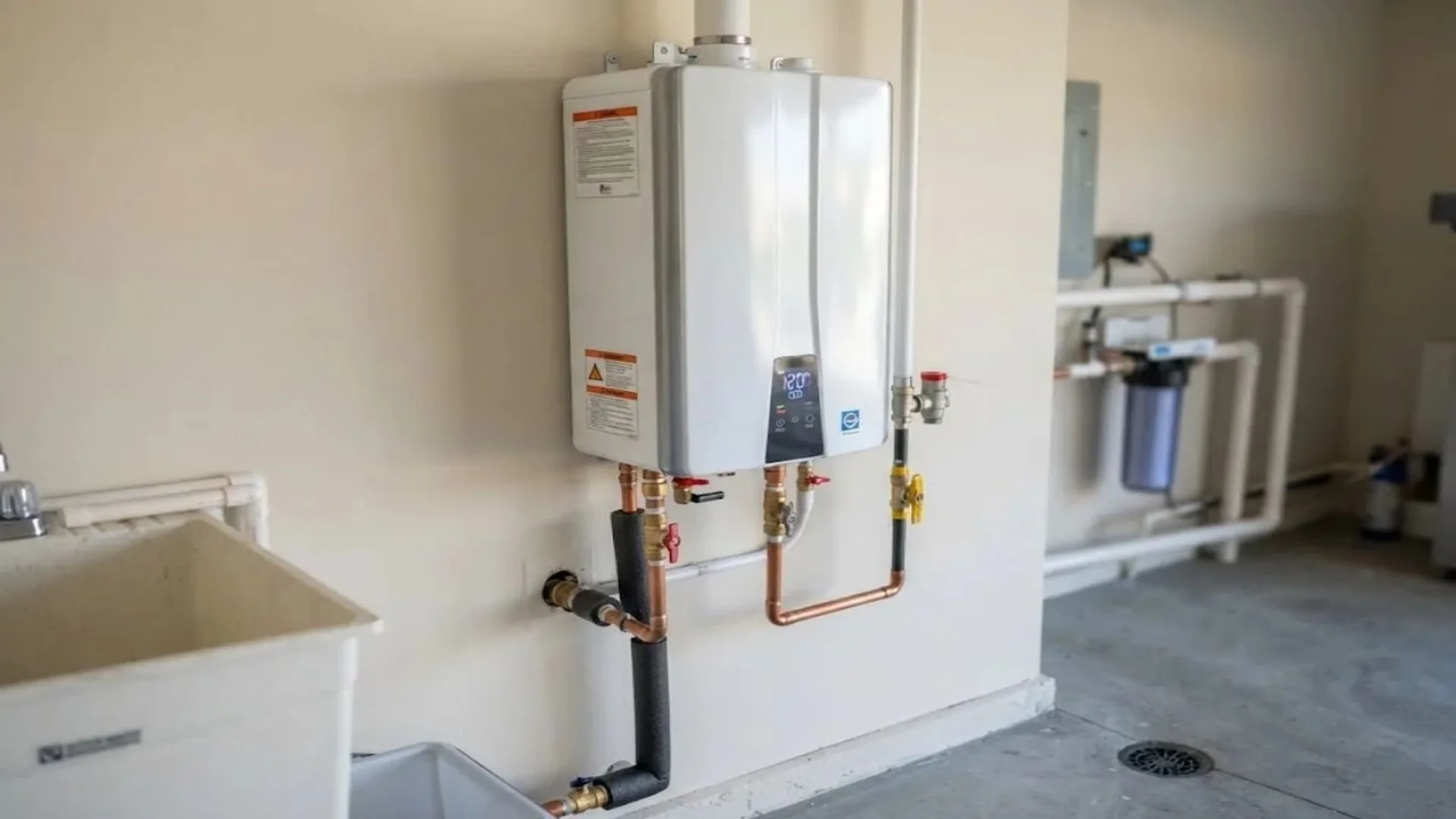
If your tankless water heater is leaking, shut off the gas at its valve, close the cold water valve feeding it, and switch off its power. Then dry the area and look for the source. Water on the floor under a tankless unit usually comes from a loose fitting, a failed valve or a cracked heat exchanger, and only the last one means the unit is likely done.
Do these three shutoffs before anything else, even if the drip looks small. Gas, water and electricity all meet at this appliance, and a slow leak can reach the control board. The sections below sort the causes from the simple to the serious.
Stop the leak safely: do these in order
Work from the top of the list down. Skip nothing, and stop if you smell gas.
- 1
Smell for gas first
If you smell gas or hear a hiss, leave the house and call 911 or the gas utility from outside. Do not flip switches on the way out.
- 2
Close the gas valve
The gas shutoff is a handle on the pipe below the unit. Turn it so it sits crosswise to the pipe. Our tankless water heater service covers both gas and electric models.
- 3
Shut the cold water valve
Closing the cold supply stops new water from flowing into the leak. The isolation valves on most units also have a hot side you can close.
- 4
Cut power
Unplug the unit or turn off its breaker. Water near a live control board is the reason this step comes before mopping.
- 5
Contain and photograph
Put a pan or towels under the leak and take a photo of where the water is coming from. That image helps whoever diagnoses it.
Where tankless units leak and what each source means
Location of the drip tells you most of the story. Wipe the unit dry and watch where the first bead returns.
| Where the water appears | Likely cause | What it usually means |
|---|---|---|
| At the water connections | Loose or worn fitting or washer | Often a simple repair once the unit is isolated. |
| At the isolation valves | Worn valve seal or o-ring | Valve service or replacement, not a new unit. |
| From the pressure relief valve | Excess pressure or a failing valve | Needs diagnosis, since the relief valve is a safety device. |
| From the condensate line or trap | Blocked drain or a failing neutralizer | Cleaning or part replacement, common on condensing models. |
| From inside the cabinet | Cracked heat exchanger or internal leak | Often a major repair or replacement. |
| Around the vent connection | Condensate escaping the flue | Needs a technician to check the venting. |
Never cap or plug a pressure relief valve to stop a drip. For a leaking unit that still runs, water heater repair is usually the first step.
Safety steps for a leaking tankless heater
- Turn off the unit's power at the breaker and close its gas valve.
- If you smell gas, leave and call 911 or DTE Energy from outside.
- Close the cold water shutoff to the unit.
- Do not touch the unit or wiring while standing in water.
- Avoid open flame near the heater.
- Let hot water in the unit cool before you touch any part.
Why scale is behind so many tankless leaks
Tankless units heat water very quickly through a narrow heat exchanger. Minerals in the water, mostly calcium and magnesium, build up on those surfaces over time. The scale restricts flow, raises internal temperatures and can stress fittings and seals until one gives way.
Hard water speeds this up, which is why flushing the unit on a regular schedule is the usual maintenance advice. A leak that shows up alongside error codes, noisy operation or fluctuating hot water is often tied to scale rather than a defective part.
Flushing helps most when it is done before problems appear. After a leak has started, the plumber needs to find out whether scale caused damage that flushing cannot reverse.
What to tell the plumber when you call
A few details speed up the diagnosis and help the dispatcher plan the right parts.
- Give the make and model from the label on the unit, and say whether it burns gas or runs on electricity.
- Describe where the water appears, and share your photo if you took one.
- Say whether the leak is constant, only when hot water runs, or only when the unit fires.
- Mention any error code that was showing on the display.
- Say whether you have flushed the unit and roughly when it was last serviced.
- Tell us whether the gas, water and power are now off so the visit can start from a safe point.
Tankless leaks: the manual and the code
A leaking tankless unit is governed first by its manufacturer's instructions, including shutoff steps and warranty conditions. If the heater must be replaced, Wyoming requires a plumbing permit and the work follows the 2021 Michigan Plumbing Code, based on the 2021 IPC.
Read the warranty terms before anyone opens the unit. Warranty terms often depend on who does the work and how the unit was installed, and the manufacturer's paperwork is the final word on that.
Repair or replace: how the decision usually falls
Repair usually makes sense when
- The leak is at a fitting, valve, washer or condensate part.
- The heat exchanger is intact and the unit works otherwise.
- The unit is relatively young and replacement parts are available.
Replacement is worth discussing when
- Water comes from inside the cabinet or the heat exchanger is cracked.
- Scale damage has affected several parts at once.
- The cost of the repair approaches the cost of a new unit.
- Parts for the model are hard to find.
Call the plumber, not the warranty line, first
Warranty claims often need a licensed installer's diagnosis, so having a plumber confirm the cause and photograph the damage tends to make the claim smoother. Keep your install paperwork handy. Customers in Walker and Byron Center can reach the same dispatch line, including through our Walker team.
Tankless leaks and replacement rules in Wyoming, MI
City and neighboring utility reports put hardness for Lake Michigan water in the area in the 140s ppm, roughly 8 to 9 grains per gallon. That is moderately hard to hard water, so scale is a realistic cause of a leaking tankless unit here, and a test of your own tap tells you how much to expect.
Wyoming's Building Inspections office requires a plumbing permit before work starts on hot water heater replacement. If your leaking unit needs to be swapped rather than repaired, ask about the permit at 616-530-7285 before the new unit goes in. The permit is applied for online or on paper, and the permit holder must be licensed by the State of Michigan for that work unless the owner lives in the home.
You can look up any plumber's license through the LARA licensee lookup on the state website. Checking before the visit takes a minute and tells you whether the person quoting the job is licensed for it.
Questions readers ask about this job
It can be, because it involves gas or high electrical load next to water. Shut off the gas, water and power right away, and leave the house if you smell gas.
It is better not to. A small leak can worsen without warning, and moisture can damage the control board or corrode venting.
The valve opens when pressure or temperature is too high, or when it has worn out. Do not block it. Have a plumber find out which one is happening.
Hard water leaves scale in the heat exchanger, and that can contribute to leaks and poor performance. Regular flushing and a water softener are common ways to slow it down, and city reports put local hardness in the 140s ppm.
Replacement of a hot water heater falls under the city's plumbing permit rule, so confirm with Building Inspections before work starts.
If the job turns out to be more than a weekend project, our team handles tankless water heater and water heater repair, and the same 24/7 line covers Walker and Byron Center.
Leak under your tankless unit?
Shut off gas, water and power, then call (855) 575-2890 and our 24/7 dispatch will get a plumber on the way.