
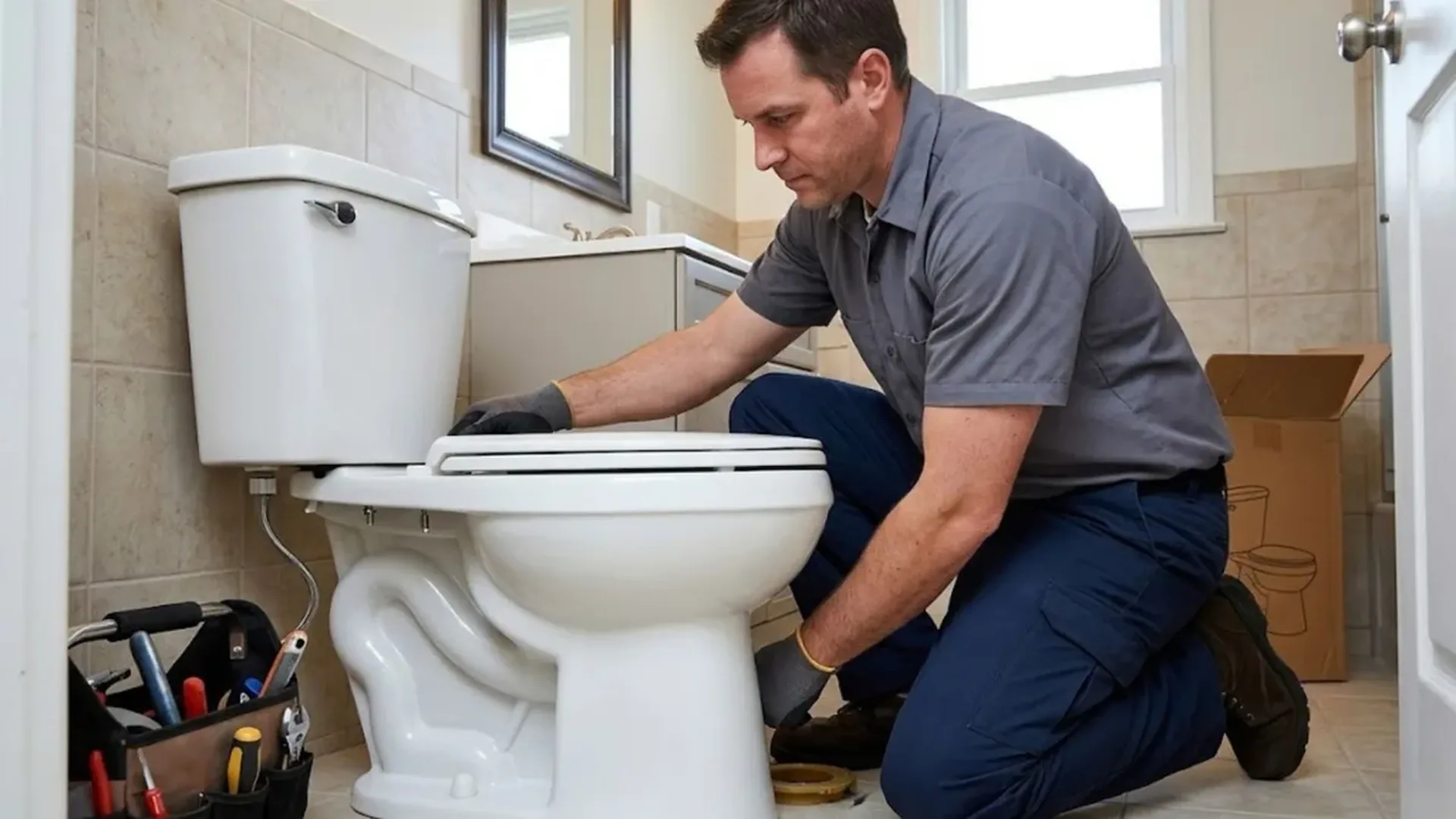
If a toilet is overflowing or water is spreading from its base, shut the small valve on the wall behind it by turning it clockwise, then call our 24/7 line. The valve stops new water entering the tank, which usually halts an overflow within seconds. We dispatch day and night for toilet repair in Wyoming, and a leaking base or a failing seal does not need to wait for morning.
A toilet is a simple machine: a tank that stores water, a valve that refills it, a flapper that releases it, and a trap that carries waste away. Almost every failure is one of those four parts.
What fails inside the fixture
Match the symptom to the part and you can usually tell whether the fix is small.
Flapper
The rubber seal at the bottom of the tank lets water slip into the bowl when it warps or gets coated with film. The tank refills over and over, and you hear the toilet run on its own.
Fill valve
This is the tall assembly that refills the tank and shuts off at a set level. When it sticks or its seal wears, water never stops entering and spills down the overflow tube.
Wax ring and flange
The wax ring seals the toilet to the drain flange under the bowl. A leak at the floor, a slight rock, or a faint sewer smell usually points here.
Trap and drain
A blocked trap gives a slow flush, gurgling or a bowl that fills and sits. Plunging helps with paper blockages, while a toy, wipe or buildup needs an auger.
Supply line and shutoff
The braided line and the small valve behind the toilet can drip at the connection or stick closed. A valve that will not turn is a repair in its own right.
Toilet overflowing or leaking onto the floor
Overflowing water carries waste, so treat the room as contaminated. Do not flush again, and keep children and pets out until it is cleaned and disinfected.
If the supply valve will not turn, or water comes from the floor rather than the bowl, call right away. After-hours and weekend calls get the same triage as daytime ones, and we offer same-day appointments when available for problems that can hold until morning.
- Turn the wall valve behind the toilet clockwise to stop refilling.
- Lift the tank lid and push the float down if the valve will not close.
- Soak up standing water with towels and open a window for air.
- Do not use chemical drain cleaner, which can splash and damage the fixture.
- Note whether other drains gurgle, which suggests a deeper blockage.
When a toilet job turns into permit work
Replacing a flapper or fill valve is plain repair. Resetting a toilet on a new flange, moving it, or adding a bathroom involves drains and fixtures, which Wyoming covers with a permit and the 2021 Michigan Plumbing Code, based on the 2021 IPC.
You must be licensed by the State of Michigan for that work or be the owner and resident of the home.
Repair or replace: how to decide
The age of the toilet matters less than what is failing and how many parts have already worn out.
| Situation | Repair | Replace |
|---|---|---|
| Running tank | Usually repair: new flapper or fill valve | Only if the tank is cracked |
| Leak at the base | Usually repair: new wax ring and bolts | If the flange or floor is badly damaged |
| Cracked bowl or tank | Not repairable | Replace the fixture |
| Frequent clogs | Clear the trap, check the vent | If the older low-flow design cannot keep up |
| Rocking toilet | Reseat with new ring and shims | If the flange is broken |
What you can do and where to stop
Some toilet fixes are safe for a homeowner. These are the lines we suggest not crossing.
- Do replace a flapper, which clips on and costs little.
- Do try a plunger with a full seal before calling about a slow flush.
- Do not pull the toilet if you cannot lift it, because most are heavy and awkward to manage alone.
- Do not force a stuck shutoff valve, since the stem can snap and leave water running.
- Do not keep flushing a bowl that has not drained, as it will overflow.
- Call if water appears around the base, the floor feels soft, or the same clog returns within days.
Toilet leaking or running?
One call tells you whether it is a small part or a replacement.
Wax rings, flanges and floor leaks
The wax ring is a soft gasket between the toilet and the floor drain. When the toilet rocks, the ring compresses unevenly and can let water seep out with each flush, often soaking the subfloor over time. Replacing it means lifting the toilet, cleaning the flange and setting everything level again.
The flange is the metal or plastic ring screwed to the floor. If it is cracked, corroded or sitting too low, a new ring will not seal it, and the repair becomes a flange fix. Soft flooring around the base is a sign to call sooner than later.
Mineral buildup and the Lake Michigan supply
City and neighboring utility reports put hardness in the 140s ppm, roughly 8 to 9 grains per gallon, so test your tap. In practice, that means mineral scale gradually coats the flapper seat, the fill valve and the fill hole under the rim. A toilet that starts to run after a few years may need a cleaned seat and a new flapper rather than a new fixture.
Fixing the old toilet versus fitting a new one
Repair makes sense when
- The bowl and tank are intact.
- One part has failed.
- The toilet flushes strongly when it works.
- You like the height and shape.
Replacement makes sense when
- Hairline cracks show in the china.
- Parts keep failing in sequence.
- The flush needs repeated attempts.
- You want a taller or more efficient model.
New installs, moves and permits
Swapping a toilet in the same spot is straightforward. Adding a new toilet or moving one is adding a fixture, and Wyoming Building Inspections requires a plumbing permit before that work starts. Tell us at the start, because the permit and the inspection date shape the schedule. Our installation service covers new bathrooms and fixture additions.
What affects the price of a toilet repair
Toilet work ranges from a small internal part to a full fixture and flange replacement.
Homeowner's insurance generally covers sudden water damage but not wear-related toilet repairs, so photograph any damage before you start cleanup.
We give a clear price before work starts, so call (855) 575-2890 for the real number.
Questions about toilet repair & installation in Wyoming
Yes. Our dispatch line runs 24/7, so an overflow at midnight or a leak on a holiday weekend gets the same attention as a weekday call. Shut the wall valve first, then call.
A slow leak past the flapper lets the tank level drop until the fill valve kicks in. In Wyoming's moderately hard water, mineral film on the flapper seat is a common culprit.
Do not force it. Close the main water valve if water is running, then call. A stuck valve is a small repair, but a snapped stem can turn into a flood.
Usually yes. We lift it, check the flange, replace the wax ring and reset the toilet level. If the flange is broken, we will show you before repairing it.
You can, and we install customer-supplied fixtures. It helps to confirm the rough-in distance from the wall first so the new toilet fits the old drain location.
Yes. We use augers to clear the trap and branch, and we will tell you if the line behind it needs a camera look. Nearby readers in Grandville can call the same line.
Stop the water, then call
Close the wall valve and we will take it from there at any hour.