
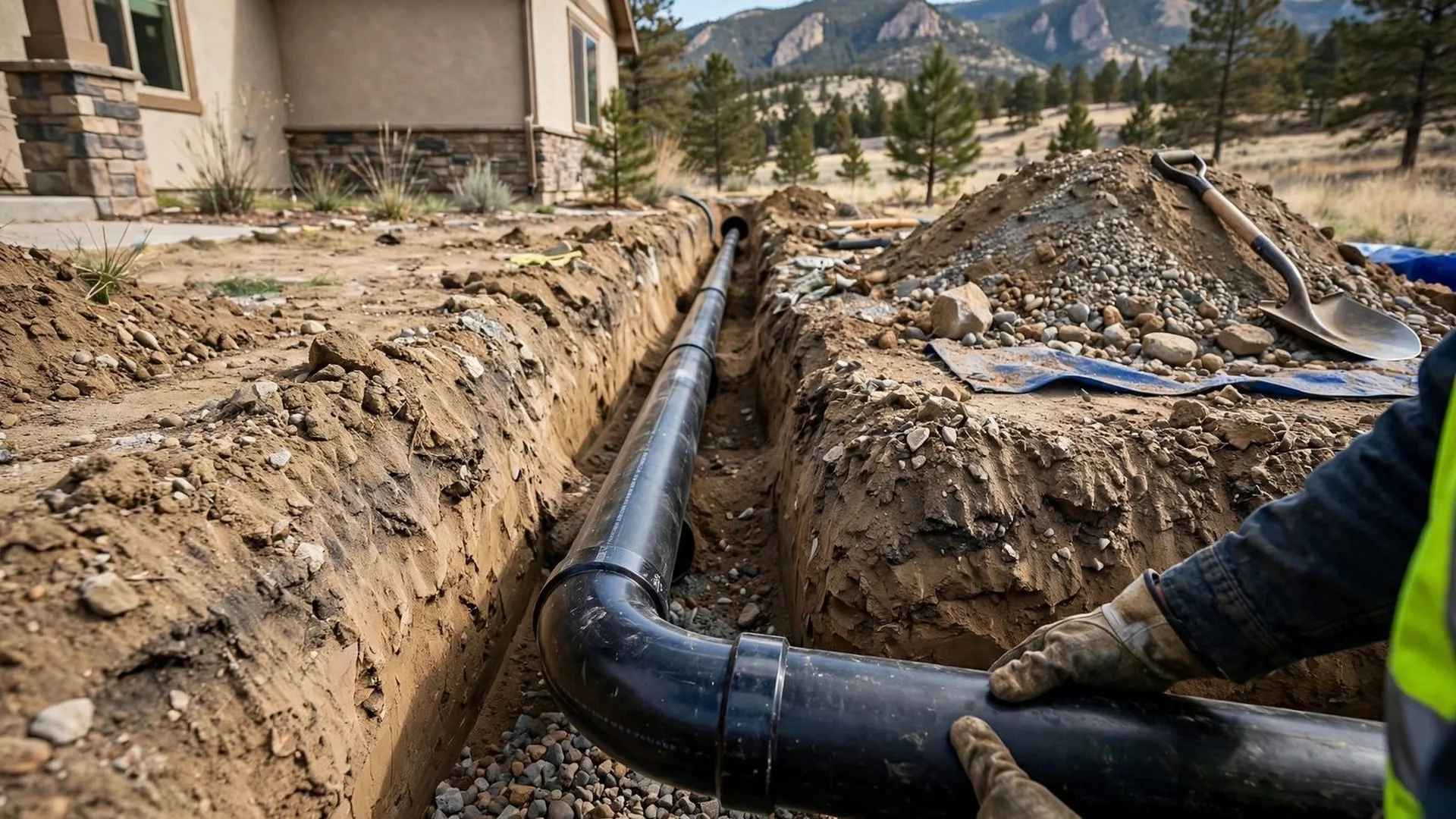
Epoxy sewer line repair means pulling a resin-soaked liner into an existing pipe and curing it into a new, thin pipe inside the old one. In Wyoming, MI, it works best on a line that is cracked, root-invaded or leaking at joints but still round and still in place. It does not work on a pipe that has collapsed, sagged into a belly or separated.
Nobody can tell which case you have by looking at the lawn. A camera inspection of the line comes first, and the answer decides everything else. Below you will find how lining works, a table of what it fits, and how the city's side of the sewer differs from yours.
How a liner actually gets into the pipe
A crew cleans the old line first, usually with a cable or water jetting, so the liner can bond to bare pipe wall. A felt or fiberglass sleeve is soaked in resin, then pulled or inverted through an access point such as a cleanout. Air or steam presses it against the pipe wall while the resin hardens.
The result is a smooth inner pipe, often called cured-in-place pipe. Roots lose the cracks and joints they were feeding on. Because the work happens through one or two small openings, most of the yard stays intact.
The liner is not a magic coat of paint. It adds strength, but it relies on the host pipe still holding a basic round shape. If the old pipe has fallen apart, there is nothing to line. When that happens, a traditional sewer line repair with a short dig is the honest answer.
Which sewer problems lining fits and which it does not
Use this as a starting point for the conversation, not a verdict. The camera footage makes the final call.
| Condition on camera | Lining a good fit? | Why |
|---|---|---|
| Hairline cracks and leaking joints | Usually yes | The liner seals the openings and gives roots nothing to enter. |
| Root intrusion at joints | Yes, after cutting roots | Roots must be cleared first or the liner will not seat properly. |
| Rough, scaled cast iron interior | Often yes | Descaling gives the resin a surface to grip, though wall thickness still matters. |
| Collapsed or crushed section | No | The liner cannot pass through, so that stretch needs excavation or another method. |
| Belly holding standing water | Rarely | Lining follows the existing slope, so a sag stays a sag. |
| Offset or separated joint | Usually no | A liner can bridge small gaps but not a pipe that has moved apart. |
A mixed line may need a short dig at one bad spot and lining for the rest.
Does a pipe liner need a permit?
Lining a sewer pipe is still work on a drain, and the 2021 Michigan Plumbing Code (2021 IPC basis) governs drain systems. Wyoming requires plumbing permits for drain replacement, so ask the contractor and Building Inspections whether a liner counts at your address before you sign.
The liner maker's instructions set the preparation and curing steps. Verify the installer's state license through LARA.
What a sound lining job looks like from start to finish
The order matters. Skipping the first step is the most common reason a lining job disappoints.
- 1
Camera inspection
A camera runs the length of the line and records it. You should see the footage, with the problem spots pointed out, before anyone talks about a method.
- 2
Locate and measure
The crew marks where the line runs and how deep it sits, and notes every bend. Call MISS DIG 811 before any digging that the plan requires.
- 3
Clean the pipe
Roots, scale and grease are removed so the liner touches clean wall. A poorly cleaned pipe is where bonding problems start.
- 4
Install and cure
The resin-soaked liner goes in and is cured under pressure. Cure time depends on the product and the pipe length.
- 5
Reinstate and re-inspect
Side connections are reopened and the camera runs again. That second recording is your proof the liner is smooth and the openings are clear.
Questions to settle before you agree to a liner
A short list keeps the decision about your pipe rather than the sales pitch.
- Ask to watch the full camera recording and have each defect explained in plain words.
- Confirm whether the damage is on your side of the property line or in the city's section.
- Ask what happens at sags, offsets and collapsed spots, and whether a spot dig is part of the plan.
- Have the crew describe how side connections, such as a branch from a bathroom, get reopened.
- Ask whether a permit applies and who will pull it.
- Get the post-lining camera recording in writing as part of the finished job.
Lining or digging: an honest trade-off
Where epoxy lining wins
- Little disturbance to lawns, driveways and landscaping.
- Fewer open trenches, which matters for lines under pavement.
- Roots are shut out at joints and cracks.
- Smooth interior helps flow.
Where excavation wins
- Collapsed, offset or badly sagging pipe needs to be replaced, not coated.
- A short dig can fix one failed section in a line that is otherwise sound.
- You can reset slope and see the soil conditions directly.
- Some damaged pipe cannot hold a liner at all.
A liner shrinks the pipe a little
Every liner takes up a sliver of the old pipe's inner diameter. In most residential lines that trade is acceptable because the smooth wall carries water better than the rough one it replaced.
On a small or already restricted line the margin is thinner, which is one more reason the camera and measurements come before the quote. If you live just across the border in Kentwood, the same logic applies, and our Kentwood plumbers can help.
Epoxy sewer repair and the city line in Wyoming, MI
The City of Wyoming accepts responsibility for sanitary sewer mains and the residential connections within the right of way. If a backup starts on the city side, Public Works coordinates the repair at no cost to you. That means a failing section near the street is not something to line at your own expense until the city has looked at it.
Public Works has staff on call 24/7 for sewer backups and asks residents to call before hiring a plumber, at 616-530-7260. Make that call first, then call a plumber if Public Works finds the problem on the private side. A camera run from your cleanout usually shows which side the damage sits on, and that recording is useful to hand to the city.
If the problem is on the private side, the homeowner hires a plumber and pays for the repair. Lining is one option for that stretch. Building Inspections at 616-530-7285 can tell you whether your specific work needs a permit, since the city requires permits for replacing drains and adding fixtures, and you can check any contractor's state license through the LARA licensee lookup.
Questions readers ask about this job
It is a long-lasting repair when the old pipe was a good candidate, but permanence depends on the pipe, the cleaning and the installation. A liner cannot fix slope problems or a pipe that keeps moving.
It shuts roots out of cracks and joints because the liner seals them. Roots can still push on a pipe from outside, and they can grow toward any new opening, so the line should still be inspected from time to time.
Often yes, since many liners are installed through an existing cleanout. The crew needs enough straight access and a route clear of obstructions, which the camera inspection confirms.
It depends on where the problem is. The city handles sanitary sewer mains and connections within the right of way at no cost, while a problem on the private side is the homeowner's cost. Call Public Works first at 616-530-7260, and they can tell you the next step.
Slow drains throughout the house, gurgling toilets and repeated backups point to the main line. A camera shows whether the cause is roots, a crack, a sag or a collapse.
If the job turns out to be more than a weekend project, our team handles sewer line repair and sewer inspection, and the same 24/7 line covers Kentwood and Grandville.
Get the camera on your line first
Call (855) 575-2890 and we will set up a camera inspection so the repair choice rests on what is actually in the pipe.