
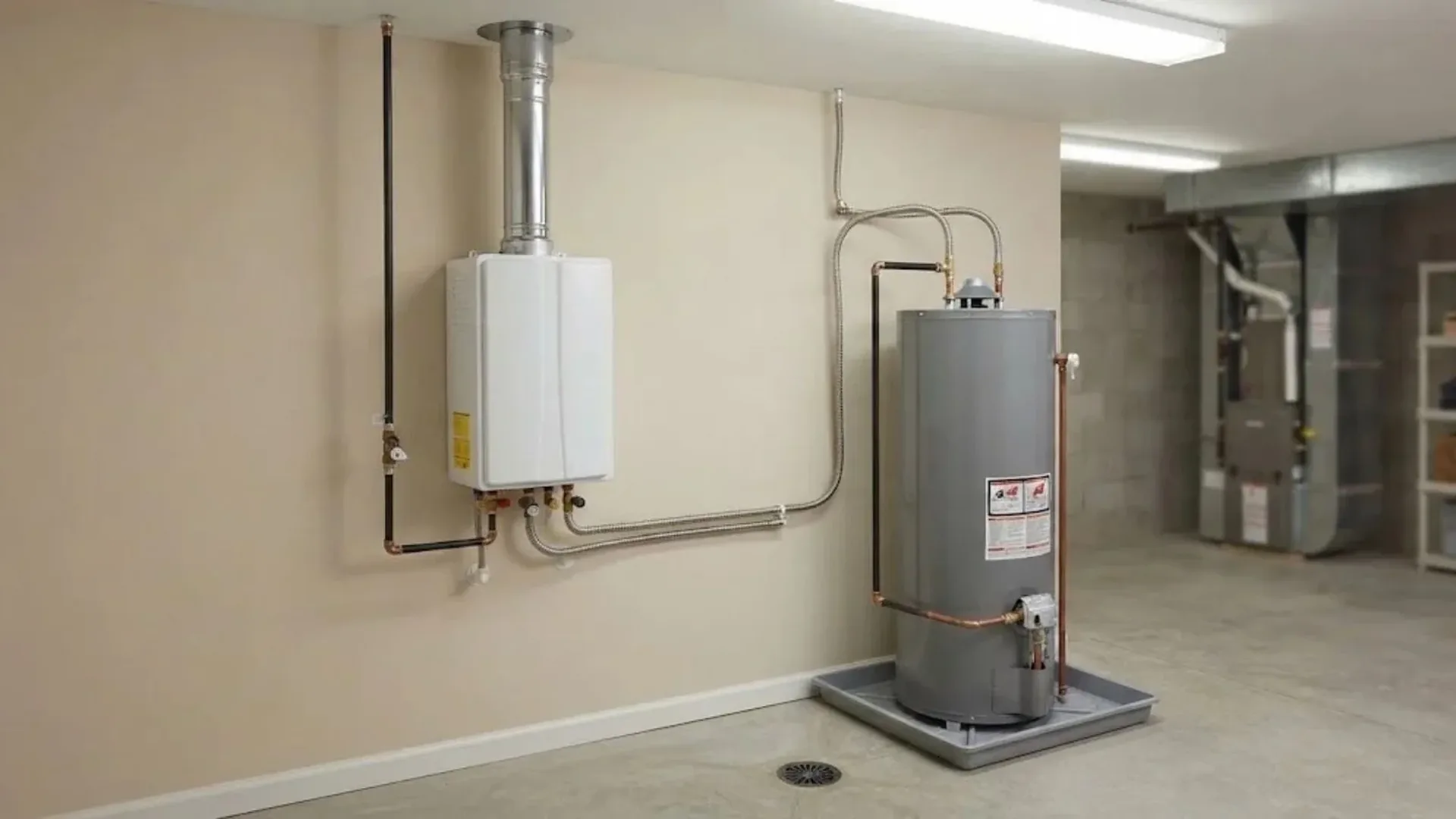
Hard water leaves a chalky crust inside a tankless heater's heat exchanger, the same crust you see in a kettle. A flush circulates a descaling solution through the unit, dissolves that crust, and rinses it out. Most owners do it with a small pump, two hoses, and a bucket.
Your manual comes first. Brands differ on the solution, the flush time, and the shutoff sequence, so follow the manufacturer's steps wherever they differ from this guide. If your unit has no isolation valves, tankless water heater service can fit them so future flushes take less effort.
What scale does inside a tankless unit
A tankless heater heats water on demand through a narrow metal passage. Scale narrows that passage, forces the unit to work harder, and shows up as fluctuating temperatures, weak flow, or an error code. Left alone, it can lead to a failed heat exchanger.
Because the water passes through quickly, even a thin film matters. That is why tankless owners in hard water areas flush on a schedule instead of waiting for symptoms. Your manual states how often, and local hardness usually pushes the answer toward the shorter side. The same chemistry applies in Grandville, where the city's report lists a similar hardness.
What you need on the bench before you start
Gather everything first. A flush interrupted halfway leaves the unit full of acid solution.
| Item | Why it matters | Notes |
|---|---|---|
| Small submersible pump | Moves solution through the heat exchanger and back | A pump rated for the solution, not a pond pump |
| Two hoses with fittings | Connect the service ports to the bucket | Garden-hose threads are common, check yours |
| Descaling solution | Dissolves scale | Use the product the manual names, white vinegar is the common choice |
| Five-gallon bucket | Holds the circulating solution | Clean, and large enough for a few gallons |
| Isolation valve kit | Lets you close off the unit and flush it | Fitted by a plumber if you lack them |
| Safety gear | Protects eyes and hands | Gloves and goggles, and a ventilated room |
The flush, from shutdown to first hot tap
This is the general order. Where your manual disagrees, trust the manual.
- 1
Turn the unit off and let it cool
Switch off power or the gas supply as your manual directs, then wait until the unit and its pipes are no longer hot. Never work on a heater that was just running.
- 2
Close the water and gas valves
Shut the cold supply, the hot outlet, and the gas valve with the isolation valves. Open a hot tap to relieve pressure.
- 3
Connect the hoses to the service ports
Attach one hose from the pump to the cold service port and the other from the hot port back to the bucket. Open the purge caps on the valves as the manual shows.
- 4
Circulate the solution
Pour enough solution into the bucket to cover the pump, start it, and let it circulate for the time your manual specifies. Many manuals call for about an hour, so check yours.
- 5
Drain and rinse with clean water
Shut off the pump, drain the bucket, and flush the unit with fresh cold water until it runs clear and the smell is gone.
- 6
Clean the inlet filter and restart
Remove the inlet screen, rinse off the debris, and refit it. Close the service ports, open the valves, run a hot tap to purge air, then restore power or gas and test the heat.
Your unit's manual sets the rules for a flush
A descaling flush is maintenance, so no plumbing code section tells you how to do it. The manufacturer's instructions govern the procedure, the descaling solution and the valve kit.
The 2021 Michigan Plumbing Code, based on the 2021 IPC, matters when work goes beyond maintenance. Replacing the heater, for example, needs a Wyoming permit. Follow the manual for your model, not a generic video.
Safety checks that apply to every brand
- Disconnect or switch off power and gas before opening any valve or cap.
- Keep the room ventilated, because descaling acid has fumes.
- Never mix descaling solution with bleach or other cleaners.
- Wear gloves and eye protection when pouring and when disconnecting hoses.
- Check every fitting for drips before you walk away.
- Leave gas line work to a licensed plumber, and electrical faults to an electrician.
Skip the flush and call if you see these
An error code that comes back after a flush, a heat exchanger that rattles, or water that never heats may mean a failed part, not scale. A pinhole leak at the unit, a gas smell, or a flame that looks wrong should stop the job immediately. Close the gas valve, leave the area, and call the gas utility for a smell of gas. For anything with the unit itself, our team can inspect it.
Flush less often by treating the water
Flushing removes scale after it forms, but a softener or filter reduces how much forms. The softener swaps hardness minerals for something gentler, so the heat exchanger stays cleaner between flushes. Water softener and filtration installers can size a system to the household.
A softener is not a replacement for the manual's schedule, though. Water treatment changes the odds, not the rules. Keep flushing at the interval the manufacturer states, and log the dates on a tag at the unit so you do not guess next year.
Hard water and tankless heaters in Wyoming, MI
Wyoming draws its water from Lake Michigan through the Donald K. Shine Drinking Water Plant. City and neighboring utility reports put hardness in the 140s ppm, roughly 8 to 9 grains per gallon, so test your tap. That is enough mineral to coat a heat exchanger over time, so plan on the shorter end of your manual's flush interval.
The city mails its water quality report before July 1 each year and keeps copies at City Hall, the Wyoming library, and online. Read it once a year and compare the calcium and magnesium figures with your last flush. If the numbers sit high, a softener moves from nice-to-have to sensible.
Hiring out is simple to vet. Michigan's LARA licensee lookup shows whether a plumber holds the state license, which matters for gas connections and any new isolation valves. For a heater swap rather than a flush, the city's permit page lists hot water heater replacement as permit work.
Questions readers ask about this job
Follow the interval in your manual. Hard water usually calls for the shorter end, and a household with a softener may stretch it a little. Logging the date helps you avoid skipping a year.
Many manufacturers name white vinegar, and others name their own descaler. Use what your manual specifies, and never mix it with bleach or other cleaners.
They make the job practical. Without them you would have to drain and cut into the plumbing. A plumber can add them in a single visit.
Scale builds up, flow and temperature drop, error codes appear, and the heat exchanger can fail early. Skipping flushes can also affect warranty coverage, so check your paperwork.
Local reports put hardness at roughly 8 to 9 grains per gallon, so test your tap. That is hard water, so scale is a steady companion here, and a regular flush is a good habit.
If the job turns out to be more than a weekend project, our team handles tankless water heater and water softener & filtration, and the same 24/7 line covers Grandville and Walker.
Would you rather hand the flush to a pro?
Call (855) 575-2890 and we will book a licensed plumber for the descaling or the isolation valves.