
When a main line is backing up at 2 a.m., our 24/7 dispatch line at (855) 575-2890 is open, and until we arrive you can stop using water and keep the lowest drain area clear.
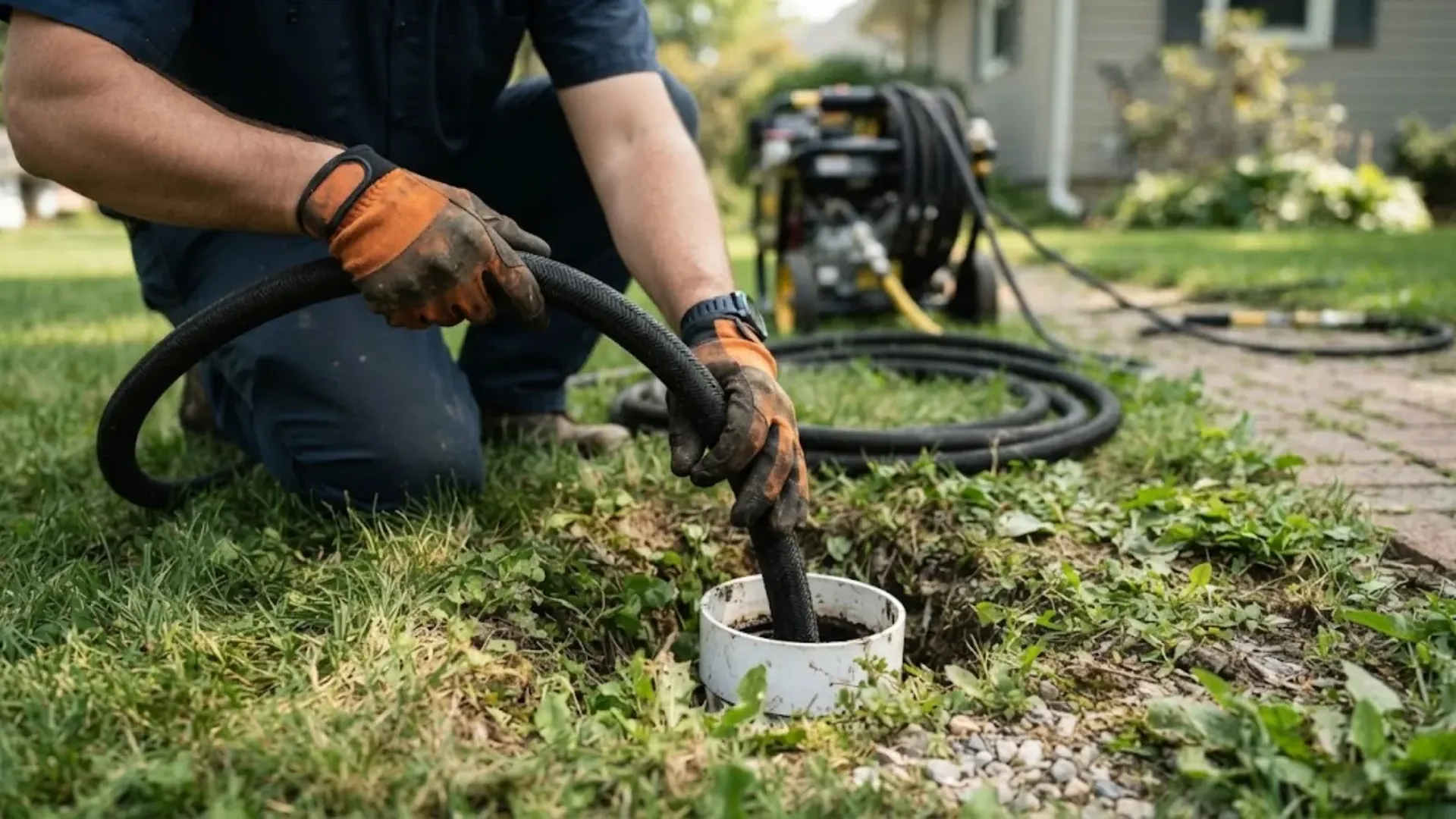
Hydro jetting in Wyoming means cleaning a drain or sewer line with high-pressure water instead of a spinning cable. A nozzle on a hose sends jets backward to scour the pipe wall and forward to pull itself along. It is the tool we reach for when ordinary snaking has not held.
Signs a snake is not enough
Cable machines are fast and fine for many clogs. These patterns tell us the problem is bigger than a single plug.
The clog returns
Cleared in spring, slow again by fall. A cable cuts a hole through the blockage but leaves most of the coating on the pipe, so the line narrows again.
The snake stalls
The cable goes in, hits something, and will not move on. That could be a mass of roots, a heavy scale ring or a pipe problem, and each needs a different answer.
Slow drains all over the house
When the tub, kitchen sink and washer all drag together, the buildup is often spread through the main rather than sitting in one spot.
Roots keep growing back
A cutting head clears a channel through roots, but the root mass remains. Water pressure removes far more of it from the pipe wall.
Grease from a kitchen or restaurant line
Cooled fat bonds to pipe walls in layers. Water at high pressure peels it away instead of boring through the center.
Jetting versus snaking, side by side
Both methods have a place. This is how they compare on the jobs we see most.
| Factor | Snaking | Jetting |
|---|---|---|
| How it works | Cable and cutting head break through | Pressurized water scours the full pipe wall |
| Best for | Local clogs, hair, a single fixture | Grease, scale, roots, repeat clogs |
| What it leaves behind | A coating that can re-grow | A near-clean pipe interior |
| Access needed | A trap, vent or cleanout | A cleanout or open end of the line |
| Risk to weak pipe | Low if sized right | Higher, so we camera-check old pipe first |
For a plain sink or tub clog, our drain cleaning service is usually where we start.
What roots, grease and scale actually do inside a pipe
Roots find the small gaps at pipe joints, drawn by moisture and nutrients. Once inside, they grow into a mat that catches paper and waste. Jetting with a root-cutting nozzle can remove the mat across a longer stretch than a cable can.
Grease behaves differently. It forms a smooth, thick lining that tightens the opening from every side, so a snake punches a small hole and water finds a way through for a while. Jetting strips the lining so the pipe returns closer to its original diameter.
Scale is mineral buildup, and it is rougher and harder. Cast iron develops a crusty interior over decades, and that surface catches debris like a net. Jetting can knock down a good portion of it, though heavily scaled pipe may also be thin, which is the reason for a camera look first.
Older cast iron and clay lines need a look first
Many Wyoming houses date to the 1950s building boom, and the sewer lines under them may be cast iron or clay. These materials can be brittle, cracked or partly collapsed after decades in the ground, and strong water pressure aimed at a failing pipe can make a bad spot worse.
That is why we may run a camera before we jet an older line. Our sewer camera inspection shows the pipe condition, and the result decides whether jetting is safe or whether repair has to come first.
When jetting is the wrong tool
Jetting helps when
- The pipe is intact but coated with grease or scale.
- Roots entered at a joint that is otherwise sound.
- A cable has cleared it before and the clog returned.
- You want the line clean before a camera inspection.
Skip jetting when
- A camera shows a collapsed or crushed section.
- The pipe is cracked, offset or separated at a joint.
- The line has a belly holding standing water.
- A blockage is a foreign object that needs retrieval, not scouring.
Snake keeps failing? Ask about jetting
Tell the dispatcher how often the clog returns and we will say whether a camera or jetting comes first.
If jetting shows the pipe is damaged
Sometimes the cleaning is what reveals the problem. A line that was packed with debris may open up to show a cracked section, and we would rather tell you than leave you with a clean pipe that fails again next month.
At that point the work becomes repair, and our sewer line repair page covers spot fixes, lining and replacement. In Wyoming, replacing drain piping needs a plumbing permit from the city's Building Inspections office before work starts, so we plan that into the schedule rather than treating it as an afterthought.
Sewage backup that a snake could not clear
If waste water is coming up in a basement drain, tub or toilet, treat it as urgent. Do not use water anywhere in the house, because everything you send down has nowhere to go.
Call (855) 575-2890 at any hour. We can often book a same-day appointment, and nights and weekends are handled by the same dispatch line. If more than one fixture is backing up, also call Wyoming Public Works at 616-530-7260, since the city may be responsible for the main.
- Stop all water use, including dishwasher and laundry.
- Keep children and pets away from standing wastewater.
- Move belongings off the floor near the lowest drain.
- Open a window if there is a sewage smell, and keep the area ventilated.
- Do not try pouring chemicals into the line.
- Call Public Works first if the backup affects several fixtures.
Jetting findings and the drain rules that follow
Jetting clears a line without altering it, so a cleaning visit generally needs no permit. If the camera then shows a broken pipe, the repair falls under the 2021 Michigan Plumbing Code, based on the 2021 IPC, and Wyoming requires a permit for drain replacement.
Ask to see the footage before agreeing to any repair, and confirm the plumber's state license on the LARA lookup.
How a jetting visit runs
The sequence is the same whether we are called out at midday or overnight.
- 1
Locate the access point
We find the cleanout, or the best alternative, and confirm the line size so we choose the right nozzle.
- 2
Run a camera when pipe is old or unknown
If the line is aged or the cause is unclear, we look before pressurizing it.
- 3
Jet in passes
The nozzle goes in, then is pulled back while water works on the walls. We repeat until the water returns clean.
- 4
Check flow and recheck
We run water through the fixtures and, when useful, camera the line again to confirm the result.
What affects the cost of a jetting visit
Jetting equipment is heavier than a basic cable machine, so the work usually costs more than a simple snaking. We give a clear price before work starts.
Insurance generally treats cleaning as maintenance, though a sewer backup endorsement may cover resulting damage, so check your policy.
Call (855) 575-2890 for the real number on your line, including what a camera first would add.
Questions about hydro jetting in Wyoming
Yes. Dispatch runs 24/7, and for an active backup we book a same-day appointment when one is available. Call (855) 575-2890 and describe what is backing up. The same line covers neighboring areas, including the homes on our Grandville service page.
It is safe on sound pipe, but many homes from the 1950s boom have cast iron or clay that may be cracked or thin. We recommend a camera look first so we do not push water into a weak section.
It clears far more root mass than a cable, but it does not stop roots from growing back. If roots keep entering at a joint, the lasting answer may be lining or repair, which we can discuss after a camera look.
Cleaning a line does not. Replacing drain piping does, and the city requires a plumbing permit before that work begins, which we help plan if a repair is needed.
Occasionally, but a cleanout is much better. Jetting through a fixture risks splashback, so we prefer a cleanout or an open pipe end.
It depends on what clogs it. Kitchen lines with heavy grease may need it more often, and a home with root intrusion may need a regular cycle. We suggest a schedule after seeing the line.
Clear the pipe wall, not just a hole
Call (855) 575-2890 any hour and get a price before the equipment comes off the truck.