
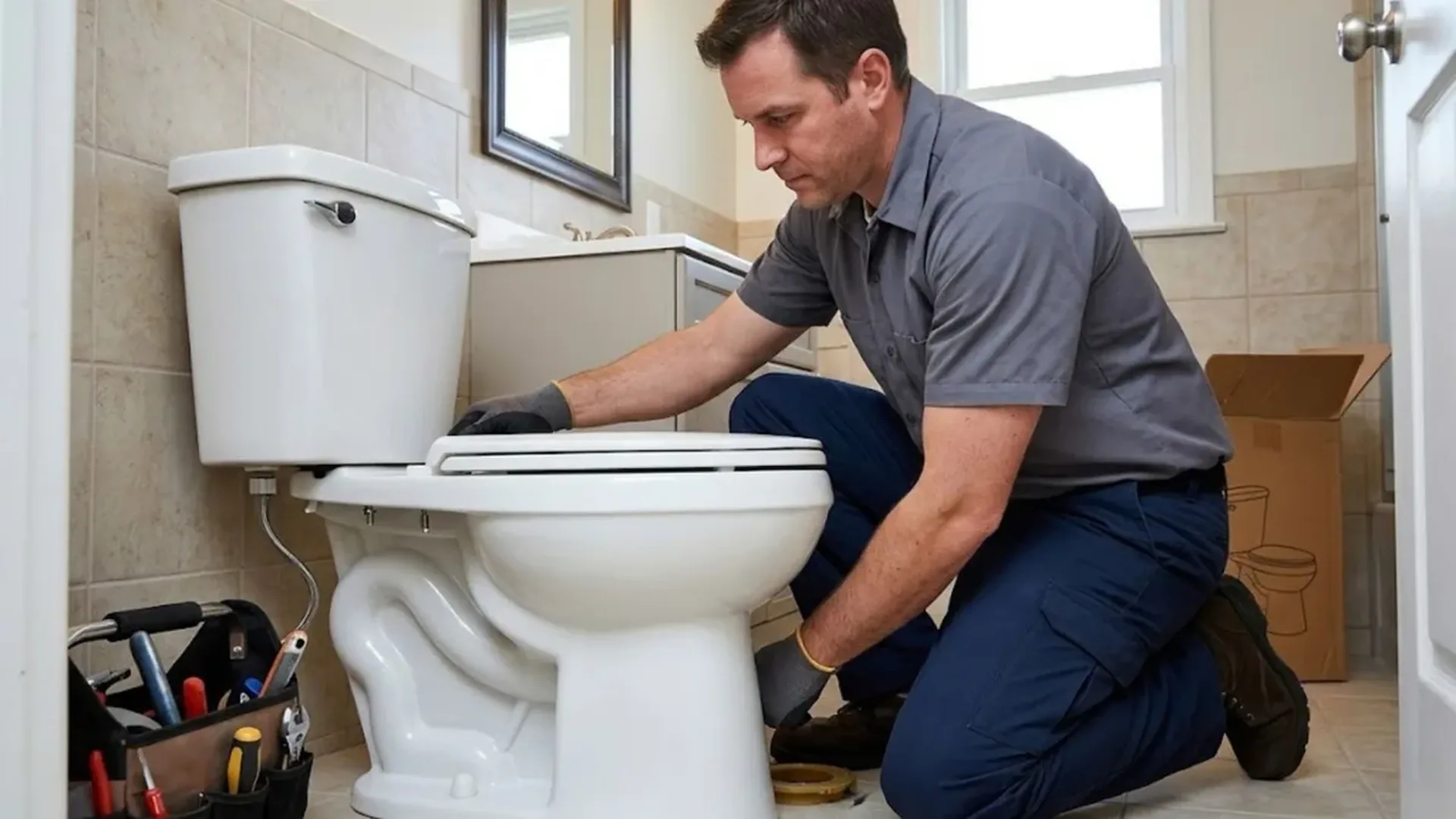
A toilet that hisses at 2 a.m. or refills by itself every few hours almost always has a tired fill valve. The part sits on the left side of the tank, and swapping it is one of the friendlier plumbing jobs for a patient homeowner. You need a new valve, a wrench or pliers, a sponge, and a clear head.
The short version: shut the stop valve, flush the tank empty, unscrew the supply line and the locknut under the tank, drop in the new valve at the right height, reconnect, and set the water level. If the stop valve itself will not close or the tank cracks while you work, toilet repair is the next call.
Signs the fill valve is the problem
Check these before you spend money on parts.
Constant hissing
Water keeps trickling in after the tank looks full. The valve seat or seal no longer closes cleanly.
Ghost flushes
The bowl level drops and the tank refills with nobody touching it. That is usually the flapper, so drop food coloring into the tank and see whether it reaches the bowl. If it does not, the fill valve is still the suspect.
Slow refill
The tank takes ages to fill, although the stop valve is fully open. Debris can clog the valve's inlet or the diaphragm may be worn.
Water running into the overflow tube
The level is set too high or the float is stuck, so water spills down the tube all day without any visible leak.
Loud banging
A noisy refill, especially at the end, often points to a worn valve or a partly closed stop valve.
Pick the valve that fits your tank
Most replacement valves are universal, but the style and height range matter.
| Valve type | Best for | Watch for |
|---|---|---|
| Float cup (cylinder) | Most modern tanks, quiet and compact | Cup height adjusts on the shank, so check the range |
| Ball float (old style) | Older tanks with a rod and a ball | Rod can bend and make the valve run on |
| Tall or low-profile | Tanks with unusual height or a tight lid | Measure from the tank bottom to the lid before buying |
| Top-fill vs side-fill | Matches where your supply line enters | Wrong inlet pattern leaves the line stretched |
Bring the old valve to the store or measure it. Heights vary more than people expect.
Installing it, one stage at a time
- 1
Close the stop valve and empty the tank
Turn the oval handle on the wall or floor clockwise until it stops. Flush once and hold the handle down. Sponge out the last of the water so the area around the valve is dry.
- 2
Disconnect the supply line
Place a towel and a small bowl under the connection, then loosen the coupling nut by hand or with pliers. Some water will drip out of the line.
- 3
Remove the old valve
Loosen the large locknut under the tank on the valve's threaded shank. Lift the old valve straight out of the tank.
- 4
Set the new valve to the right height
Follow the package instructions to adjust the shank so the top of the valve sits about an inch or two above the overflow tube. Too low and it floods the tube, too high and the lid will not close.
- 5
Tighten the locknut and rubber washer
Seat the valve with its washer inside the tank and the locknut underneath. Hand-tight plus a small turn is enough, because porcelain cracks when overtightened.
- 6
Reconnect and clip the refill tube
Attach the supply line, then run the small refill hose to the overflow tube with the supplied clip, pointing at the tube and not into the water.
- 7
Open the stop valve and watch
Turn it back on slowly. Let the tank fill, then adjust the float until the water stops about an inch below the top of the overflow tube. Flush twice and check every joint with a dry tissue.
The two-minute leak check after you finish
- Run a dry paper towel around the supply line coupling and the locknut under the tank.
- Listen after the tank is full: the valve should go completely silent, not trickle.
- Mark the water level in the tank with a pencil and check it again an hour later.
- Flush three times and watch whether the refill stops at the same level each time.
- Check the floor around the base after a day, since a slow drip hides well on tile.
When the stop valve or the tank is the real issue
If the stop valve spins without shutting off the flow, do not keep forcing it. Close the home's main shutoff instead and call for fixture and valve repair, since the same crew can replace a worn shutoff. A cracked tank or a warped base is a replacement job, not a fill valve fix.
Mistakes that cause a second trip to the store
The most common error is setting the float too high. Water then drains into the overflow tube and the valve never shuts off fully. Lower the float until the water line sits clearly below the tube's top.
The second is overtightening plastic nuts. A quarter turn past snug can crack the tank or crush the washer, and a cracked tank means a new toilet. The third is skipping the flush of the supply line: debris in the line can lodge in the new valve and make it hiss from day one. Run the stop valve open into a bucket for a few seconds before connecting.
The steps are the same for a home over in Walker, since the part and the tank design do not change.
What a running toilet means in Wyoming, MI
Inside the home, fixture leaks are the homeowner's responsibility, according to the City of Wyoming's Public Works page. A toilet that quietly refills all night is a fixture leak, and it shows up on your water bill rather than as a puddle. Fixing the valve yourself, or calling a plumber, is the way to stop paying for it.
The city's Utilities department handles water meters and inspects service lines, and its meter work uses an advanced metering system. A running toilet can look like a meter problem when it is not. Before you call the Utility Business Office at 616-530-7389 on a weekday, shut off the toilet's stop valve and see whether the meter stops moving.
The city's permit page lists new fixtures and replaced supply pipes as permit work. A fill valve is a part inside an existing tank, and it is not on that published list, but call Building Inspections at 616-530-7285 if your project grows into moving or replacing the toilet. To check any plumber you hire, use Michigan's LARA licensee lookup.
Questions readers ask about this job
It varies with water quality and use, but many last several years before the seal wears. Mineral buildup from hard water shortens that, so rinsing the inlet screen when you replace the valve helps.
It is smart to look at it. If the flapper is warped or slimy, it will keep the tank refilling even with a perfect new valve, so replacing both is cheap insurance against a repeat repair.
Check that the float is set low enough and that the supply line is not kinked. If it still hisses, the stop valve may be partly closed or debris is in the valve seat. Remove the valve cap, flush the seat with water, and reassemble.
Not often, since the overflow tube sends excess water into the bowl. If the tube is blocked or the tank is cracked, it can. Know where your stop valve is and how to close it.
According to the city, fixture leaks inside the home are the homeowner's responsibility. Leaks at the meter or in the street go to the city, so shut off the toilet stop valve first to find out which side the problem is on.
If the job turns out to be more than a weekend project, our team handles toilet repair & installation and faucet & sink repair, and the same 24/7 line covers Kentwood and Walker.
Toilet still running after your fix?
Call (855) 575-2890 and a dispatcher will send a licensed plumber for the valve, the stop, or the whole toilet.