
A leak you cannot see is still costing you money, and a leak you can see is already damaging something. We also cover Walker and the neighboring cities. Our 24/7 dispatch line takes leak calls at any hour, and while you wait you can close the main valve and photograph the meter dial.
Leak detection in Wyoming means finding exactly where water is escaping from a supply line, drain or fixture before anyone cuts into a wall, floor or yard. The goal is one small, accurate repair instead of a large guess.
Start with the symptom: what your house is telling you
Most leaks announce themselves in ordinary ways long before water pools anywhere. Match what you are seeing to the likely cause, then use the sections below to see how we confirm it.
Meter moving with everything off
If the dial or low-flow indicator keeps turning while no tap, toilet or appliance is running, water is leaving somewhere. The leak could be inside the house, in a fixture, or on the pipe between the meter and the foundation.
A bill that jumped for no reason
A sudden increase with the same household habits usually points to a steady leak or a toilet that refills on its own. Check the previous few bills side by side before you assume the utility made a mistake.
A brown ring on the ceiling
Ceiling stains that grow after someone showers upstairs suggest a drain or supply leak above. Stains that grow after rain suggest a roof problem, which is a roofer's job and not ours.
A warm spot on the floor
A patch of floor that feels warm underfoot can mean a hot supply line leaking beneath it. The same patch may smell musty or sound faintly like running water at night.
Low pressure that came on gradually
Pressure that fades across weeks often means a pipe is losing water before it reaches the fixtures. Corroded fittings and partly closed valves can do the same thing, so we rule those out as well.
The meter test you can do before we arrive
A meter is the most honest leak detector in the house. It takes a short quiet stretch and tells us whether the leak is inside or outside.
- 1
Stop all water use
Turn off taps, dishwasher, washing machine and ice maker. Pause any irrigation controller and make sure nobody flushes during the test.
- 2
Read the meter
Open the lid and note the small leak indicator and the sweep dial. Take a clear photo so you can compare it later.
- 3
Wait and look again
Come back after a stretch of time with the water still off. If the indicator is spinning or the reading has changed, water is escaping.
- 4
Close the main and recheck
Shut the home's main valve and watch the meter again. If it stops, the leak is inside the house. If it keeps moving with the main closed, the leak is on the supply side before the valve.
Meter leaks and who the city wants you to call
Wyoming's own rules treat the meter as a dividing line. Leaks at the meter go to the Utility Business Office at 616-530-7389 during business hours, and to Public Works after hours. Fixture and sprinkler leaks inside the home are the homeowner's responsibility.
That split saves you money and time. If water is bubbling out of the meter pit itself, call the city first. Leaks at the meter are handled through the city's Utility Business Office or Public Works, so ask them before you pay for a repair. If the meter test shows a leak but the pit is dry, call us and we will find it on your side of the line.
Wet ceilings, damp walls and attic stains
Water travels. A drip at the ceiling is rarely under the pipe that is leaking, because water follows framing, ducts and wiring before it shows itself. We trace the stain back along the likely routes instead of opening drywall right under it.
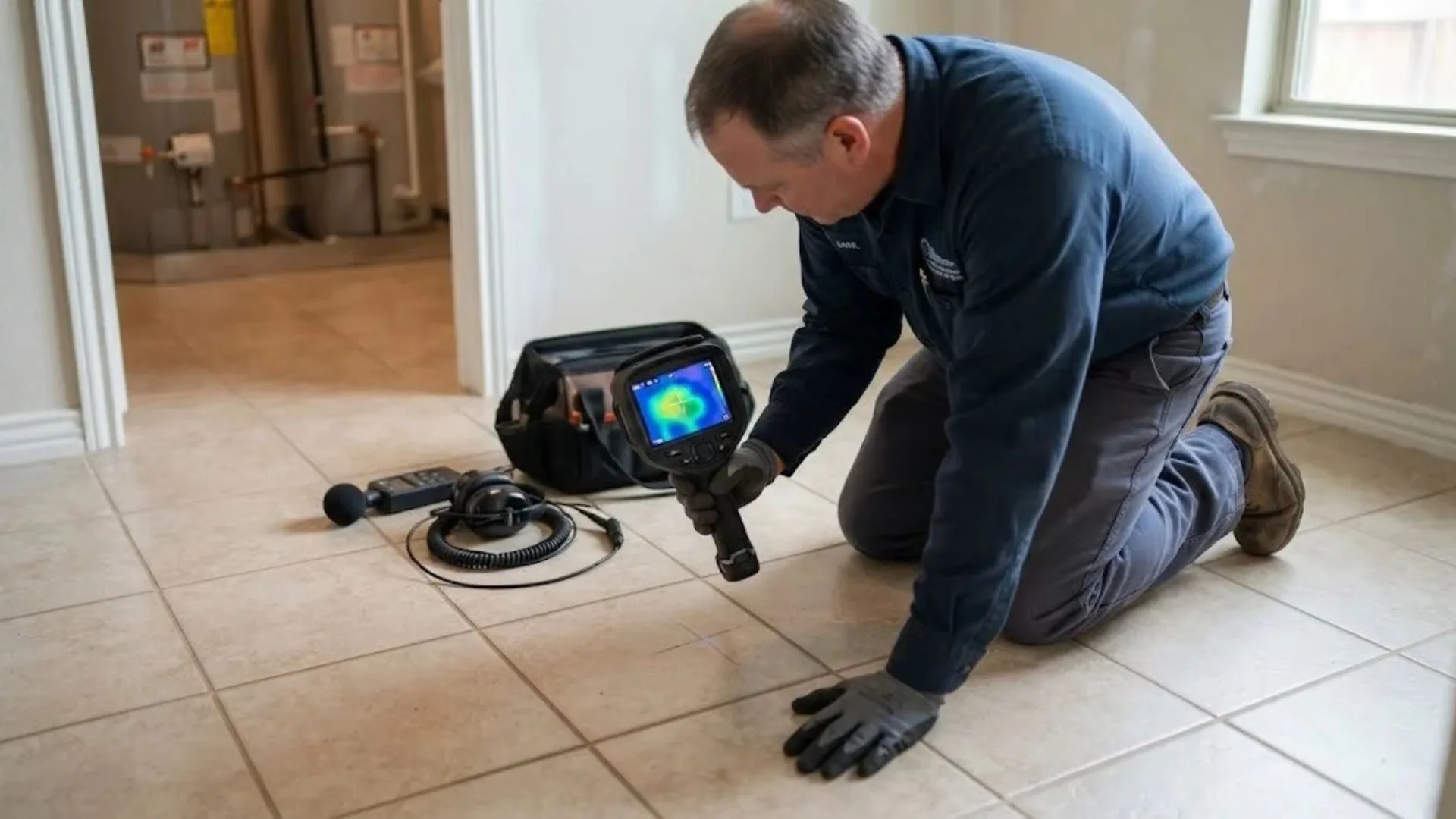
For hidden wall and ceiling leaks we use a moisture meter, thermal imaging to show cooler wet areas, and a pressure test on the suspect line. A typical call starts with the stain, then a check of the bathroom or laundry above it, then an isolation test that closes off one branch at a time.
If the leak turns out to be a failed pipe rather than a slow drip, burst pipe repair takes over. We stop and fix the plumbing source. We do not dry out, remove or rebuild wet drywall and insulation, and we do not repair roofs. Your insurer or a restoration company handles that side, and photos taken before we start help your claim.
Who needs to know before a leak repair starts
Finding the leak needs no permit. Fixing it can. Under Wyoming's rules, replaced water supply pipes need a plumbing permit before work starts, and the job must meet the 2021 Michigan Plumbing Code, based on the 2021 IPC.
If detection shows the leak is at the meter or in the street, the city handles it and no permit falls on you. That is one reason to locate the leak first.
Crawlspaces and under-house leaks
Many Wyoming homes from the post-war building boom sit over a basement, but some have a crawlspace under an addition or a porch. A leak there is easier to reach than one under concrete, yet it often goes unnoticed for months.
Signs include a musty smell, sagging insulation, rust on hangers and fittings, and a damp patch on the soil below a drain or supply line. We inspect the visible runs, test them under pressure, and look closely at joints, valves and old repairs where the pipe changes material.
Meter still turning? Talk to dispatch
Call (855) 575-2890 and describe the meter reading, the stain or the noise, and we will line up the right equipment.
Buried line leaks between the meter and the house
The pipe that carries water from the meter to your foundation is out of sight, which is why its leaks last so long. Look for a patch of lawn that stays green or soggy in dry weather, a sunken spot, or a meter that moves even when the main valve inside is closed.
We narrow it down with acoustic listening equipment and, where useful, tracer gas that escapes at the break and is picked up at the surface. Before any digging, someone must call MISS DIG 811 so buried utilities are marked. If the line itself has failed, repairing or replacing the service line is the next step.
Slab leaks: real, but not the whole story here
Slab leaks are pipes leaking in or under a concrete floor. They are common in some parts of the country, but many homes here have basements, so most hidden leaks are in walls, ceilings and exposed basement runs rather than under concrete.
Slabs do appear under garages, additions, enclosed porches and some slab-on-grade homes. If you have a warm floor spot, a hissing sound at night or unexplained meter movement in one of those areas, we test for a slab leak using acoustic and thermal equipment before suggesting anything.
How we find what is hidden
No single tool finds every leak. We match the method to the symptom and use the least invasive one first.
| Method | What it finds | Best used for |
|---|---|---|
| Pressure testing | Whether a line holds pressure or loses it | Isolating one supply branch |
| Acoustic listening | The sound of water escaping under pressure | Buried lines and slabs |
| Thermal imaging | Temperature differences from wet or hot-water leaks | Walls, ceilings and warm floors |
| Tracer gas | A harmless gas rising through the soil at the break | Buried lines that are hard to hear |
| Camera inspection | The inside of a drain or sewer line | Suspected drain leaks and cracks |
Equipment varies by situation, and we explain which method we chose and why.
Water is actively escaping or the meter will not stop
Active leaks get worse fast, and a cracked fitting can release a lot of water in an hour. Slow the water down first, then call our 24/7 line so dispatch can book the next available plumber, with same-day appointments when available.
- Close the main shutoff valve, usually near the meter or where the line enters the house.
- Open a low tap to drain pressure from the pipes.
- Photograph the meter dial, the leak and any stains with the time visible.
- Move belongings away from the wet area and lift rugs off the floor.
- Call your insurance company if water has reached walls, ceilings or flooring.
Irrigation and pool leaks, honestly
Sprinkler leaks are a common reason a meter moves when nobody is home. A cracked head, a split lateral or a stuck valve can run for days. We can check the plumbing that feeds the system, but irrigation zones and controllers belong to a landscaper or irrigation contractor, and the city treats sprinkler leaks as the homeowner's responsibility.
Pool and spa leaks are a mixed bag. We look at the supply and return plumbing and the fill line to the pool. Liner, shell and pump repairs are a pool service company's work, and we will say so plainly if the leak is outside our scope.
What affects the price of leak detection
Detection cost depends on how hard the leak is to reach and how many methods it takes, not on a flat rate. You get a clear price before work starts.
Some homeowner policies cover sudden leak damage and sometimes the cost of finding the leak, while slow seepage over time is often excluded, so read your policy or ask your agent.
Call (855) 575-2890 for your real number before we start.
Fix the leak now or watch it a little longer
Act today when
- The meter moves with every fixture off
- You see staining that is spreading
- There is a musty smell or warm floor
- Your bill has jumped without a cause
You can reasonably wait for a daytime visit when
- A single faucet drips slowly
- The main valve is closed and nothing is wet
- A toilet running is the only symptom
- You have already stopped the supply to that fixture
Questions about leak detection in Wyoming
Close the home's main valve and recheck the meter. If it stops, the leak is inside the house and our team can find it. If it keeps moving, the leak is on the supply side, and if you see water at the meter itself, call the Utility Business Office at 616-530-7389 during business hours or Public Works at 616-530-7260 after hours.
Yes. The line is staffed 24/7 and we dispatch for active leaks at any hour. Shut off the main valve first if you can, then call and tell dispatch what you see.
Often yes. Thermal imaging, moisture meters and pressure tests let us narrow down the location first, so any opening is small and in the right place. Sometimes we still need an access hole to confirm and repair the pipe.
Not if your house has a full basement, which is common here. Slab leaks are more likely under a garage, an addition or a slab-on-grade house. We test before we recommend anything invasive.
No. We handle the plumbing, not drywall, flooring, mold or restoration. Take photos, call your insurer, and ask them about a restoration company.
Sprinkler leaks are the homeowner's responsibility under the city's rules. We check the plumbing that feeds the system and tell you if the problem is in the irrigation zones, which an irrigation contractor repairs.
Stop the guessing and find the leak
Our 24/7 line is open, and we explain the plan and give a clear price before work starts at (855) 575-2890.