
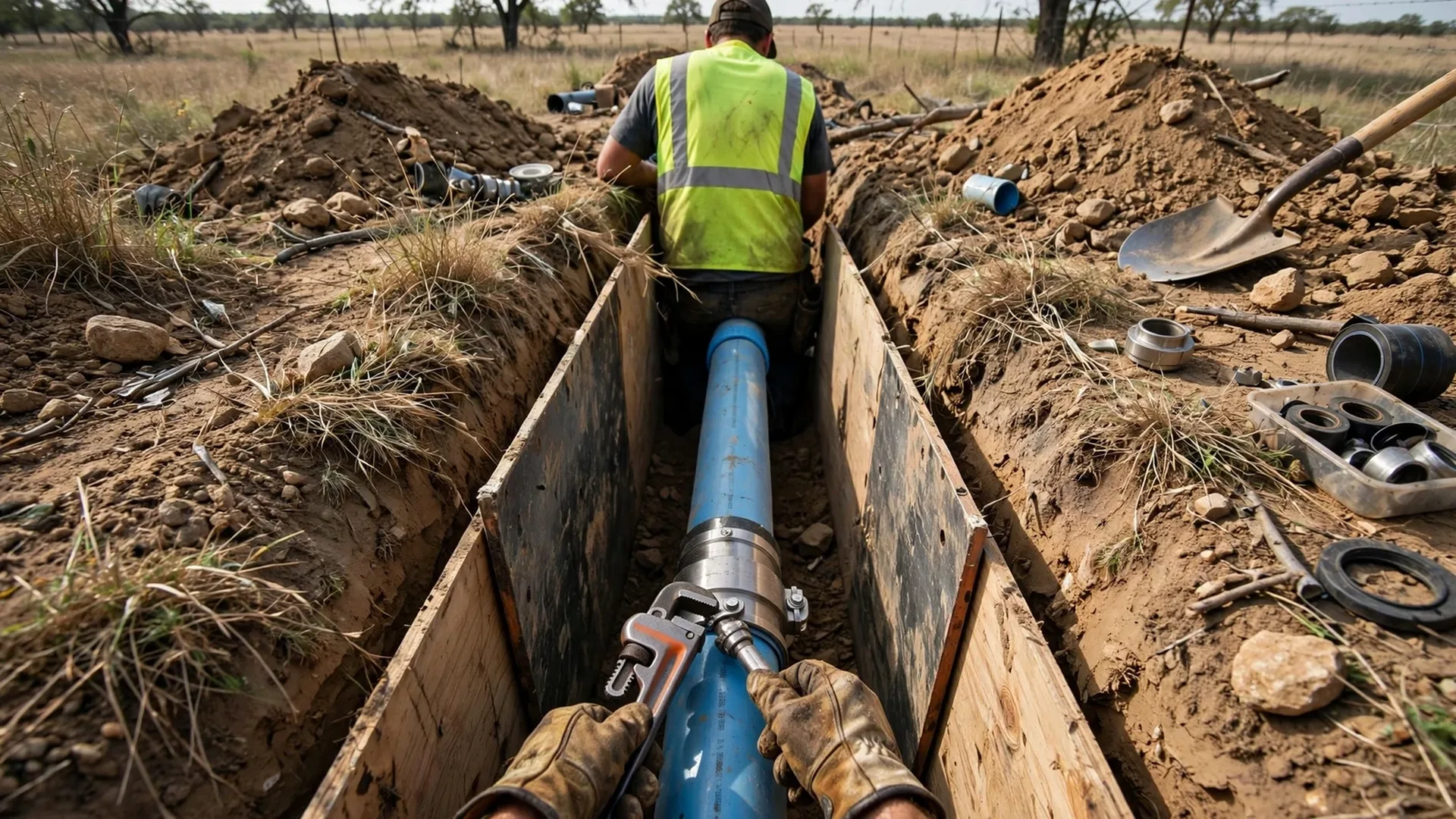
A failing water line under the yard can flood a basement or drain your pressure to a trickle. Our 24/7 line takes these calls, and you can close the main valve and take a photo of the meter while you wait for a plumber.
The water service line is the buried pipe that carries water from the street main, through the meter, and into your house. Water service line repair in Wyoming covers patching a leak, replacing a failed section or replacing the whole line.
Wet yard, spinning meter, no pressure: what each one means
Service line trouble shows up outside the walls first. These are the signs we hear about most often.
A soggy or sinking patch of lawn
Ground that stays wet in a dry week or settles into a dip may be sitting over a leaking line. Water follows the pipe trench, so the wet spot is not always above the break.
A meter that moves with the house off
If the dial turns after you close the main valve inside, the leak is between the meter and the valve. That buried stretch is exactly what this service covers.
Pressure that drops across the house
Weak flow at every tap, not just one, suggests the problem is upstream of your plumbing. A partly broken line or a crushed section can starve the whole house. Old galvanized piping inside can do the same, which is a repiping question.
Dirty or discolored water
Rust-colored or cloudy water, especially after the pressure drops, can point to corroded pipe or a break that pulls debris into the line.
Water in a basement near the wall where the line enters
Damp or flowing water at the foundation wall near the entry point suggests the line has failed close to the house.
From the street to your kitchen: who owns what
Knowing where the city's responsibility ends and yours begins can save you from paying for the wrong repair.
| Segment | What it is | Who deals with it |
|---|---|---|
| Main in the street | The large city pipe under the road | The city |
| Tap and line to the meter | The connection from the main to the meter pit | Call the city first |
| The meter | The device that measures use | City utility (Utility Business Office or Public Works after hours) |
| Meter to the house | Your buried line to the foundation | The homeowner hires a plumber |
| Inside the house | Piping and fixtures after the wall | The homeowner |
Call the city first for any water leak in the street or yard or at the meter, and call us for the line on your side.
What Wyoming's utility wants you to know before you dig
Wyoming's utility department handles water meters and inspects water service lines, so a replacement is not something to do quietly on a weekend. Ask about inspection before the trench is backfilled, because covering the pipe too early can mean digging it up again.
Water leaking in the street or on the lawn goes to Public Works, which is on call 24/7. Leaks at the meter go to the Utility Business Office at 616-530-7389 in business hours and to Public Works after hours. That quick call tells you whether the failed section is yours to pay for.
Permits for a buried water line
Replacing a water service line is permit work in Wyoming, and the city inspects water service lines. The pipe and joints must meet the 2021 Michigan Plumbing Code, based on the 2021 IPC.
Call MISS DIG 811 before any digging. Which stretch is yours depends on the meter and right-of-way, so confirm with the Utility Business Office at 616-530-7389 before hiring.
Water line emergency: flooding or no water at all
When a service line fails, the fastest step is to cut the water at the home's main valve and call for help. We dispatch around the clock, and same-day appointments are available when the schedule allows.
- Close the main valve inside the house and confirm the meter slows or stops.
- Photograph the wet area, the meter and any pooled water.
- Keep children and pets away from soft or sinking ground.
- Call Public Works if water is in the street or at the meter pit.
- Call (855) 575-2890 and tell dispatch where the water is surfacing.
Wet lawn and a spinning meter?
Call (855) 575-2890 and we will help you tell which part of the line is yours.
How a buried line is found and fixed
Digging blind is expensive. We locate the problem first, then open the smallest trench that gets the job done.
- 1
Confirm the loss
We use the meter test and a pressure check to prove the water is leaving between the meter and the house.
- 2
Pinpoint the break
Acoustic listening equipment and sometimes tracer gas narrow the location so the excavation is short.
- 3
Mark utilities and plan the dig
MISS DIG 811 must be called before digging so buried gas, electric and other lines are marked. This is a legal step and keeps the crew safe.
- 4
Repair or replace
A short section is spliced with proper fittings. A badly corroded, undersized or lead line is replaced in full.
- 5
Pressure test and inspect
We test the new line, arrange inspection with the city, and restore the trench.
Repair or full replacement: how to choose
A spot repair is cheaper today, but not always cheaper over time. If the failure is a split inside the house, burst pipe repair is the right page.
| Situation | Likely choice | Reason |
|---|---|---|
| One clean break on an otherwise sound line | Repair | The rest of the pipe may last |
| Old galvanized steel with repeated leaks | Replace | Corrosion keeps producing new failures |
| Lead line, or a line material you cannot confirm | Replace | Removes the lead question permanently |
| Line crushed by roots or heavy loads | Replace the damaged run | Patches do not restore full flow |
| Low pressure with an undersized old pipe | Replace | A larger new line can restore flow |
Lead service lines: ask, do not guess
Some older water lines in the country were made of lead, and utilities keep an inventory of the material used on each service line. The City of Wyoming links to information on its water page, so check it or call the utility and ask what material your line is made of. We do not guess based on the age of a house.
For reference, Kentwood's 2024 water quality report lists none of its service connections as lead. That is a neighboring system, not a statement about your address, so confirm yours with the city.
Low pressure is not always the line
A weak shower is more likely a clogged aerator, a failed pressure regulator or a partly closed valve than a broken service line. We check pressure at an outside hose bib and at the main before recommending any excavation.
If pressure is low throughout the house, was fine last month and the meter moves when everything is off, the buried line becomes the top suspect. In that case leak detection confirms the break before any trench is opened.
Permits and neighbors outside the city
A permit is needed in the city before replacing water supply pipes, and the permit holder schedules inspections with at least 24 hours' notice. Plan the dig and the backfill around that call so you are not left with an open trench.
Homes in neighboring Walker are on a different water system, where the utility builds the line to the right-of-way and the owner hires a plumber from there to the house. If your address is outside Wyoming, ask your own utility who owns which section.
What shapes the price of a water line job
Buried lines vary widely. You get a clear price before work starts.
Homeowner policies often exclude wear and corrosion on underground lines, though some offer optional service line coverage, so check your policy or ask your agent.
Call (855) 575-2890 for your real number before any work begins.
Questions about water line repair & replacement in Wyoming
Yes. Dispatch is staffed 24/7 and a failed buried line is treated as an emergency. If water is also in the street, call Public Works as well.
The city handles leaks at the meter, so call the Utility Business Office in business hours or Public Works after hours. If the leak is on the pipe between the meter and your house, the repair is yours.
Check the city's water page for service line information or call the utility and ask. A plumber can also look at the pipe where it enters the house, but the utility's records are the best source.
Sometimes, depending on the line and the ground. We choose the smallest opening that does the job, and we explain the options before work starts.
Yes, MISS DIG 811 must be called before any excavation. We handle that call as part of the job, and marking takes time.
It might be, but it is more often a regulator, a valve or a clogged fixture. We test pressure first and only recommend digging when the evidence points to the line.
Get your water line sorted
We locate the problem, explain repair versus replacement and give a clear price before work starts at (855) 575-2890.