
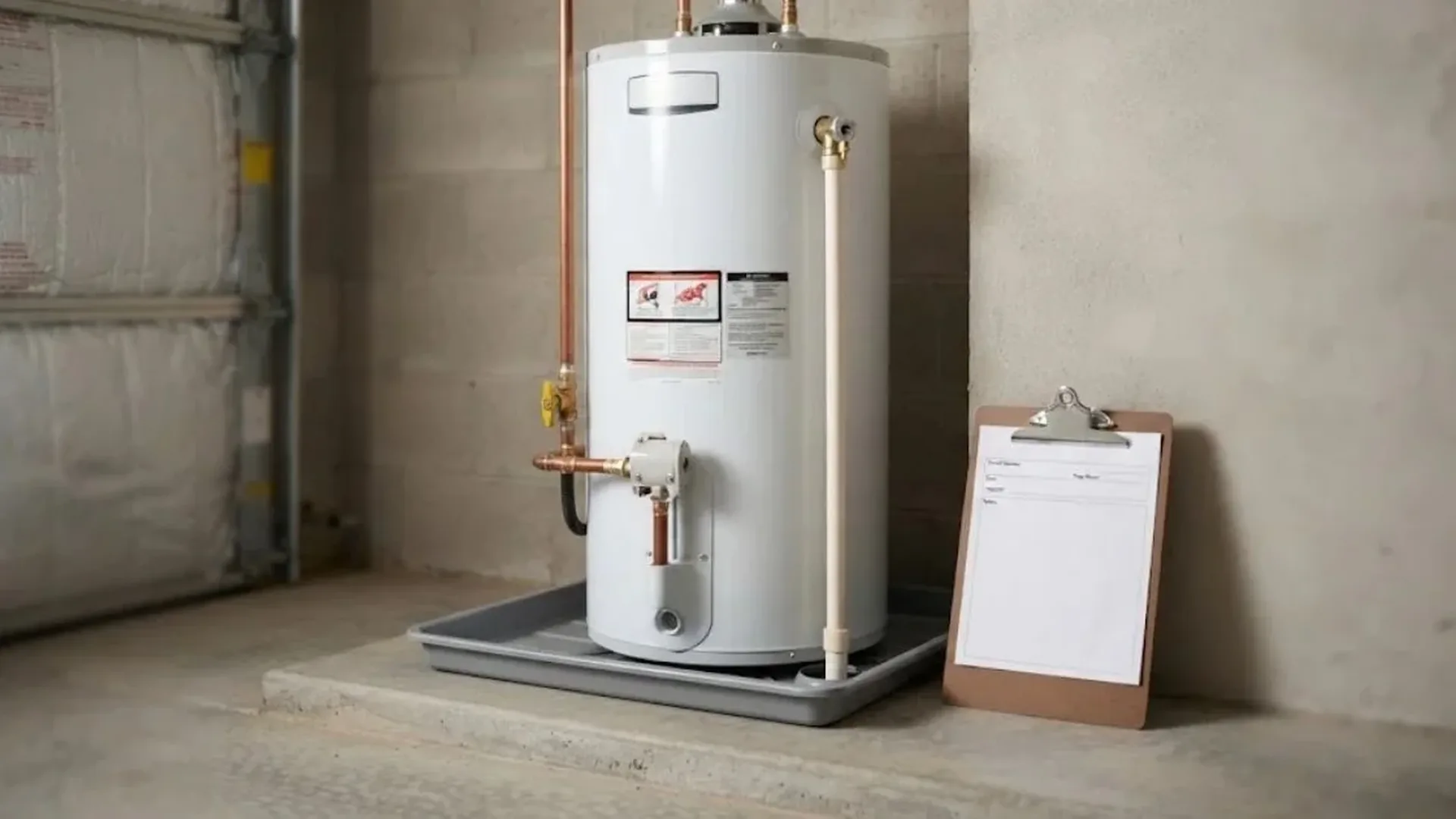
Yes, you can replace a water heater element yourself, and the job usually fits in an afternoon. The order matters more than the tools. Switch off the breaker, prove the power is dead with a tester, drain the tank below the element, and only then touch the part. Power goes back on after the tank is completely full again, never before.
This guide covers electric tank heaters only. A gas unit has no element, and a burner problem belongs with water heater repair. If the tank itself is leaking, no element will fix it, and a full replacement is the honest answer.
Find out which element you own first
Elements differ in mounting style, wattage, and voltage. Buying the wrong one is the most common reason this job gets done twice.
| Style | How to recognise it | What to match |
|---|---|---|
| Screw-in | A round threaded base with a hex or ring head, behind a small access panel | Thread size, wattage, voltage, and length |
| Bolt-on flange | An oval or triangular plate held by four bolts | Flange shape, bolt pattern, and a fresh gasket |
| Upper element | Sits behind the top panel next to the thermostat | Wattage printed on the data label |
| Lower element | Sits behind the bottom panel, often does most of the heating | Wattage, which can differ from the upper one |
| Low-density type | Longer loop with gentler surface heat | Fits the same mount, often resists scale better |
The data label on the side of the tank lists the voltage and wattage. Photograph it before you shop.
Safety gates before the panel comes off
Work through these in order. If you cannot tick every one, stop and call a licensed plumber.
- Turn the heater's breaker off at the main panel and tape a note over it so nobody flips it back on.
- Remove the access panel and insulation, then test the terminals with a non-contact voltage tester or a multimeter to confirm there is no power.
- Shut the cold water supply valve above the heater.
- Open a hot tap somewhere in the house so the tank can vent air while it drains.
- Attach a hose to the drain valve and run it to a floor drain or outdoors, then drain until the water level is below the element you are replacing.
- Keep a dry towel and a flashlight close, because the insulation behind the panel is easy to wet.
Element swaps: manual first, code second
An element swap is a repair, so the heater manufacturer's instructions are the governing guidance, including the right element type and the order of steps. The 2021 Michigan Plumbing Code (2021 IPC basis) comes into play only if you replace the whole heater.
Wyoming treats a heater replacement as permit work. If the tank itself has failed, stop and call a licensed plumber.
The swap, in the order that keeps you safe
- 1
Photograph the wiring
Take a clear picture of how the wires sit on the element terminals and the thermostat. Then loosen the terminal screws and lift the wires off.
- 2
Unscrew the old element
Fit an element wrench or a deep socket of the right size. Turn it counterclockwise with steady pressure. A stubborn screw-in element may need a longer handle and patience, not a hammer.
- 3
Clean the opening
Look at the threads or flange seat. Remove scale and old gasket material so the new seal has a clean surface to press against.
- 4
Fit the new element and gasket
Thread it in by hand first so it cannot cross-thread, then snug it with the wrench. Do not crank it as hard as you can, since the seal does the work.
- 5
Refill and check for drips
Close the drain, open the cold supply, and let the tank fill with a hot tap still open. When water runs steadily from that tap with no air spitting, close it. Look for weeping around the new seal.
- 6
Reconnect and restore power last
Put the wires back as photographed, reset the high-limit button if your thermostat has one, replace the insulation and panel, and only then switch the breaker on.
Is the element really what failed?
Symptoms point at the culprit before you buy anything. No hot water at all often means the upper element or the upper thermostat. Hot water that runs out fast or stays lukewarm usually means the lower element. A breaker that trips the moment you restore power suggests a shorted element, which can leak current into the tank.
You can confirm with a multimeter. Disconnect the element's wires, set the meter to continuity or resistance, and touch the two terminals. A healthy element reads a low but real resistance. An open circuit means a burned-out element, and a reading from a terminal to the metal base means a short.
If the element tests fine, the thermostat or the high-limit switch is the next suspect. Those parts carry live voltage, so be honest about your comfort level. We are a plumbing line, not an electrical contractor, and wiring faults behind the thermostat belong with an electrician.
A dry element dies in seconds
An element energised in air, with the tank only half full, can burn out almost immediately and can damage the tank lining. This is why the sequence ends with a full tank and a steady stream from the open hot tap before the breaker goes back on. It is also why you should never test the new element before refilling.
Why elements fail, and what slows the next failure
Most elements die from scale. Dissolved calcium and magnesium bake onto the metal, insulate it from the water, and make it run hotter until it burns through. Sediment piling up at the bottom of the tank buries the lower element and shortens its life even more. Homes in Kentwood draw from the same Lake Michigan source, so the same scale story applies there.
Draining a few buckets from the tank drain valve once a year helps clear loose sediment. A water softener or filter reduces the scale source, which is where water softener and filtration work earns its keep. If the tank is old and rusty at the drain valve, think twice before putting money into new parts.
Repair the element or replace the heater
Replacing the element makes sense when
- The tank is dry and free of rust streaks or weeping seams.
- Only one of the two elements has failed.
- The heater is not near the end of its typical life.
- Symptoms match a dead element and the multimeter agrees.
Replacing the heater makes sense when
- Water is pooling at the base or seeping from the tank.
- The drain valve runs rusty or brown after flushing.
- Both elements have failed in a short span.
- Repairs keep stacking up on an aging unit.
Element swaps and water heater rules in Wyoming, MI
The City of Wyoming's building inspections page lists replacement of hot water heaters among the work that needs a plumbing permit before it starts. Swapping one element is a repair to an existing heater, but call Building Inspections at 616-530-7285 on a weekday to confirm before you begin. If you decide on a new heater instead, expect to pull a permit and schedule an inspection with at least 24 hours' notice.
Lake Michigan supplies the city's water, and city and neighboring utility reports put hardness in the 140s ppm, roughly 8 to 9 grains per gallon, so test your tap. That is hard enough to coat an element with scale over time. A lower element that died after a few years is not a surprise here, so plan a yearly drain of the tank.
If you would rather hire out the work, Michigan's LARA licensee lookup lets you confirm that a plumber holds the right state license before you let anyone open the tank. Homeowners who own and live in the home may pull their own permit, but a contractor must be licensed by the State of Michigan for that type of work.
Questions readers ask about this job
Yes, and it is a sensible habit when one has failed from scale. The other element has seen the same water and the same sediment. Buying two means a single drain and refill cycle covers both.
Match the wattage and voltage printed on the heater's data label and on the old element. A higher-wattage element can overload the wiring and the thermostat. A lower one simply heats more slowly.
The tank needs time to heat, so give it a few hours before judging. If it stays lukewarm, the thermostat, the high-limit switch, or the second element may be the real problem. A plumber can sort that out, and wiring faults go to an electrician.
Yes. An unpowered heater is safe, though you will have no hot water. Keep the cold supply valve open so the tank stays under pressure and does not sit half empty.
The city's published list names hot water heater replacement, new fixtures, and replaced drain, vent, and supply pipes. A single element is a part inside an existing heater, so it is not named, but call Building Inspections to confirm for your address.
If you hire us, our licensed plumbers will tell you whether a permit applies before the work starts.
If the job turns out to be more than a weekend project, our team handles water heater repair and water heater replacement and water softener & filtration, and the same 24/7 line covers Grandville and Kentwood.
Stuck with a cold shower and a dead element?
Call (855) 575-2890 and a dispatcher will talk through whether this is a repair or a replacement.