
A typical call starts like this: the water bill climbed, nothing looks wet, and no one in the house can explain it. The fastest way to find a hidden water leak is the meter test. Turn off every fixture, read the meter, wait, and read it again. If the numbers move, water is escaping somewhere.
That test also tells you which half of the problem you are chasing. The rest of this guide shows how to run it, where hidden leaks tend to sit in Michigan homes, and who is responsible when the leak turns out to be at the meter or in the yard.
The meter test, step by step
You need about an hour with no water use, a flashlight and a pen. Do it when the house is quiet.
- 1
Stop every use of water
Turn off the dishwasher, washing machine and ice maker, and make sure nobody flushes a toilet. If you have a softener or humidifier that fills on its own, pause it too.
- 2
Find and open the meter
Look in the basement near where the supply enters, or in a pit outside. Lift the cover if there is one and wipe the dial clean.
- 3
Check the leak indicator
Most meters have a small triangle or dial that spins when any water moves. If it turns with everything off, you already have your answer.
- 4
Write down the reading and wait
Record the numbers, then leave the water off for an hour or so. Read the meter again.
- 5
Compare and narrow it down
If the reading changed, close the main shutoff in the house and check again. If the meter now holds still, the leak is inside your walls or fixtures. If it keeps moving, the leak is on the supply line before the shutoff. Homeowners in nearby Kentwood follow the same steps, though they should check which utility serves their address.
Where hidden leaks hide and how each one shows itself
Match what you notice to the likely location before you start opening drywall.
| Clue | Likely spot | Quick check |
|---|---|---|
| Toilet runs or hisses | Flapper or fill valve | Add a few drops of food coloring to the tank and wait without flushing. |
| Warm spot on the floor | Hot water line under slab or flooring | Feel the floor and listen for a faint hiss. |
| Musty smell, peeling paint | Pipe or drain inside a wall | Scan the wall with a flashlight at a low angle. |
| Soggy patch outside | Service line between meter and house | Look for green, soft ground when it has not rained. |
| Meter moves with water off | Anywhere on the house system | Close the main shutoff and repeat the test. |
| Bill jumps with no change in use | Slow fixture or buried line | Run the meter test before the next billing cycle. |
The usual suspects, before you suspect a broken pipe
Most hidden leaks are not burst pipes. A toilet flapper that no longer seals can lose a great deal of water without a sound. A dripping faucet, a leaking shower valve or an outdoor spigot left connected over winter all show up on the bill and nowhere else.
Supply lines under sinks and behind washing machines come next, followed by water heater connections and the pressure relief discharge line. Then come buried lines, which are harder to find because the water drains away before it surfaces. A water service line repair is the usual fix when the buried pipe is the culprit.
Michigan's freeze-thaw cycles add a seasonal wrinkle. A pipe that cracked quietly in January can start seeping when the ground thaws in spring.
Keep notes as you go. The reading you wrote down, the rooms you checked and the time you ran the test give the plumber a head start, and they can turn an open-ended search into a short one.
Walk the house first to rule out the obvious
Do this before the meter test, so you know what is already running.
- Look under every sink for damp cabinet floors, swollen wood or a musty smell.
- Check around the base of each toilet for soft flooring and test the tank with food coloring.
- Inspect the water heater, its connections and its discharge pipe for drips or mineral stains.
- Scan basement walls and the ceiling beneath bathrooms for stains or bubbling paint.
- Look at the walls behind the washing machine and dishwasher for moisture.
- Walk the yard between the street and the house for soft, unusually green patches.
- Listen at night with the house quiet for a faint hiss or the sound of water moving.
- Check outdoor spigots and sprinkler valves for drips, and confirm hoses were disconnected before the last freeze.
When a camera or sound detection is worth it
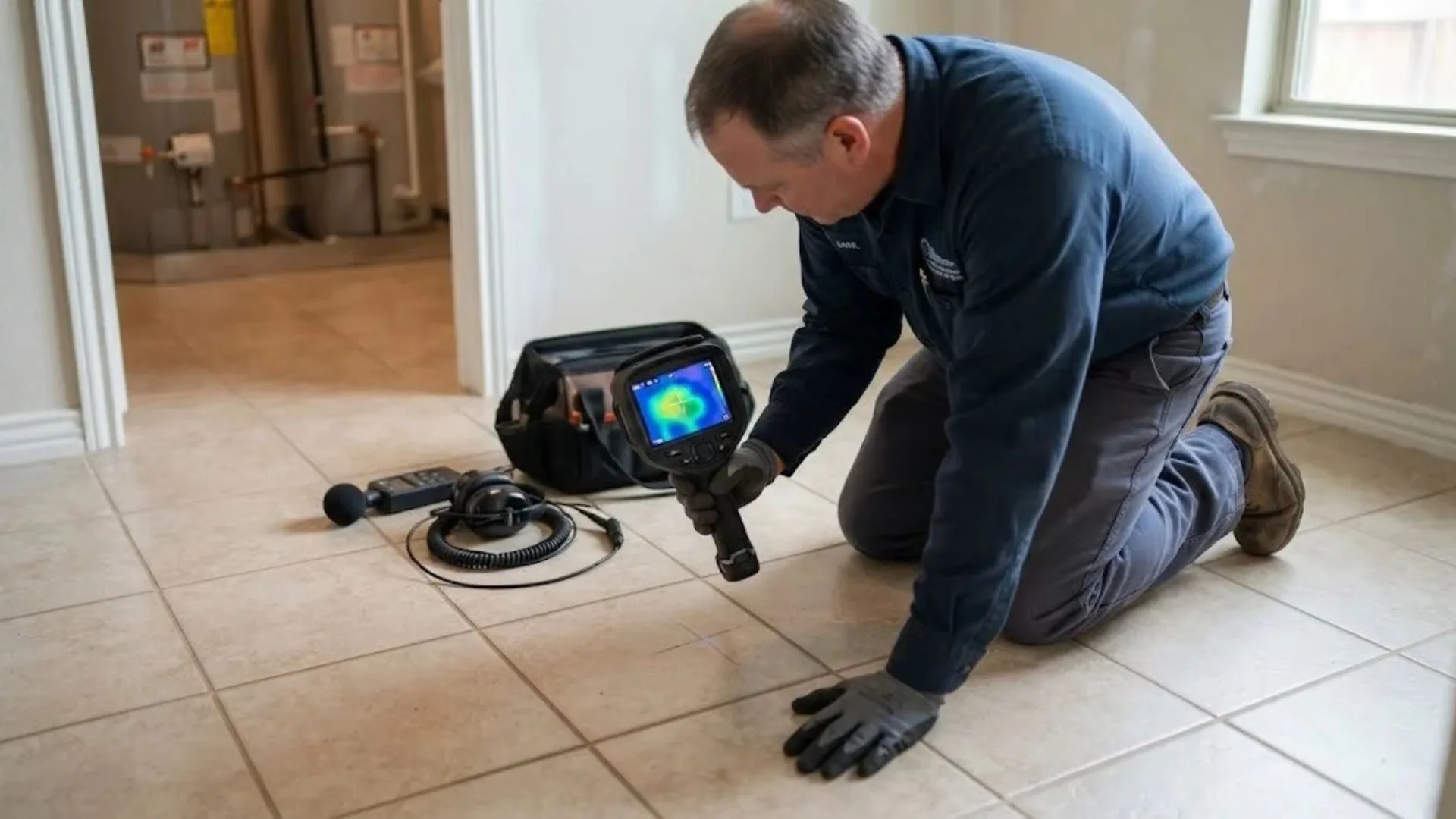
If the meter test says water is escaping but you cannot find a wet spot, pinpointing tools can listen for the leak or trace it with a thermal camera. That is a better first move than cutting open walls.
Our dispatch line can send a plumber for leak detection, so call before you pull anything apart.
Know the rules before anyone opens a wall
Finding a leak is diagnosis. Repairing it is code work. Replaced supply or drain pipe in Wyoming needs a permit, and the repair follows the 2021 Michigan Plumbing Code, built on the 2021 International Plumbing Code (IPC).
Ask who pulls the permit and who patches the wall. We do plumbing only, not water damage restoration, so drying and finishes go to your insurer or a restoration company.
Hidden leaks and the city's meter rule in Wyoming, MI
The City of Wyoming handles water meter work and inspects water service lines through its Utilities group. If your meter test points to a leak at the meter itself, call the Utility Business Office at 616-530-7389 during business hours, or Public Works after hours. The meter is the dividing line, so the call you make first saves you from paying a plumber for a city-side problem.
Water in the street or yard, or a leaking hydrant, goes to Public Works around the clock. A wet patch that appears between the street and your house is worth that call before anyone digs. If the leak is on your private line, a plumber takes it from there.
Fixture and sprinkler leaks inside the home are the homeowner's responsibility. That includes the toilet, the faucet and the irrigation valve. If you plan to replace water supply pipes as part of the fix, Building Inspections at 616-530-7285 can tell you whether a permit applies.
Questions readers ask about this job
More than most people expect, because it runs around the clock without a sound. That is why the toilet is the first fixture to test.
You can detect that a leak exists with the meter test, but pinpointing one under a slab needs listening or thermal equipment. Call a plumber instead of breaking concrete.
Call the Utility Business Office at 616-530-7389 during business hours. After hours, Public Works handles it. A leak past the meter on your own pipes is the homeowner's cost.
Yes, as long as you pause anything that fills on its own. Otherwise those units can move the dial and mislead you.
Yes, if water is actively escaping and you cannot stop it at a single fixture. Then call a plumber, and the 24/7 line is open for exactly this.
If the job turns out to be more than a weekend project, our team handles leak detection and water line repair & replacement, and the same 24/7 line covers Kentwood and Walker.
Meter still moving?
Call (855) 575-2890 and we will send a plumber to locate the leak before it does more damage.